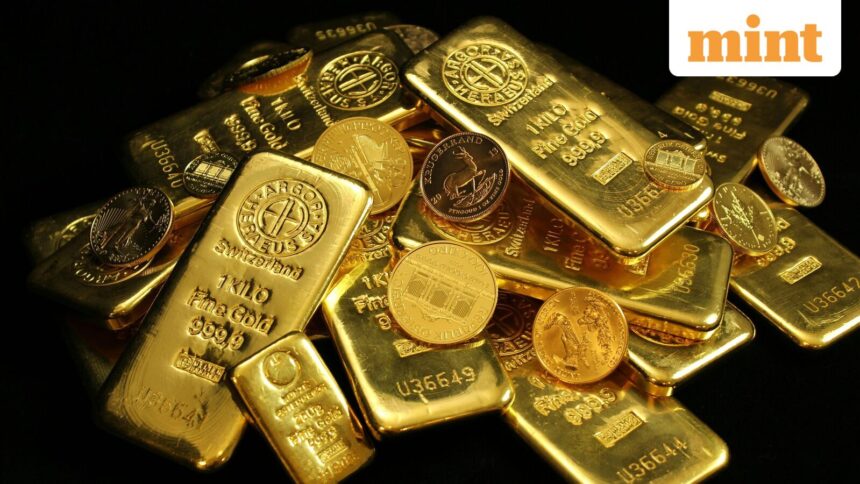
In recent trading sessions, gold prices have come under sustained selling pressure, particularly on the Multi Commodity Exchange (MCX). As of May 1, 2026, evening trade saw MCX gold futures for June delivery dipping by as much as 0.90%, amounting to a decline of ₹1,369 per 10 grams to an intraday low of ₹1,49,742, which briefly pushed prices below the ₹1,50,000 mark. The pricing strain is being attributed to rising crude oil prices amid ongoing tensions between the U.S. and Iran, which have cast doubt on the central bank’s likelihood of a near-term rate cut.
In the international markets, the downturn was echoed, with U.S. spot gold decreasing by 1.1% to $4,568.82 per ounce, indicating a probable weekly decline of approximately 1.2%. Concurrently, U.S. gold futures for June also fell by 1.1% to $4,579.70. Despite some losses over the week, gold prices had seen a slight recovery, trading 0.57% lower at ₹1,50,255 on Friday.
The recent drop in oil prices following a fresh proposal for negotiations between Iran and the United States has not entirely offset the concern surrounding elevated fuel costs. These costs are stirring worries over a potential global economic slowdown and persistent inflationary pressures. Additionally, the dollar’s depreciation against major currencies has made gold more accessible for buyers using different currencies. Experts suggest that higher costs may compel central banks to keep interest rates elevated longer, which typically impacts non-yielding assets like gold as investors pivot towards alternatives like Treasury yields.
The Federal Reserve’s decision to leave interest rates unchanged this week—a stance underscored by a hawkish outlook—has contributed to a scaling back of market expectations regarding any potential rate cuts this year. Notably, gold prices have been on the decline since late February, contrasting the metal’s typical status as a safe-haven asset during geopolitical disputes.
Market analysts have noted the impact of macroeconomic factors on gold’s trajectory. Sugandha Sachdeva, Founder of SS WealthStreet, pointed out that central bank policies have been pivotal in shaping market sentiment. While the Bank of Japan, European Central Bank, and Bank of England have exhibited cautious-to-hawkish positions due to ongoing inflation concerns influenced by rising oil prices, the Fed’s balanced, if somewhat dovish, stance has highlighted emerging labor market concerns while downplaying the risks emanating from energy price surges.
The outlook for gold remains mixed, with Ponmudi R, CEO of Enrich Money, recognizing intermittent profit-booking amid periods of selective buying near established support levels. He remarks that despite a reduction in safe-haven demand, it continues to lend support during price declines due to lingering uncertainty.
Looking forward, Sachdeva projects a cautiously positive future for gold. She emphasizes that despite anticipated near-term volatility driven by crude oil prices, movements in the dollar index, and political developments, lower price levels are expected to attract buying interest. The upcoming U.S. Non-Farm Payrolls data is anticipated to be a significant market trigger, shaping the Federal Reserve’s policy direction and influencing gold prices.
From a technical perspective, gold appears to be in a consolidation phase, with signs of base formation emerging. Current price resilience is observed around the $4,400 per ounce mark with pivotal resistance established in the $4,550–$4,600 per ounce range. On the domestic front, key support for gold is seen around ₹148,000 to ₹147,500 per 10 grams on a weekly closing basis, while a decisive breakout above the $4,868 per ounce and ₹156,000 level would signal a resumption of bullish momentum moving forward.
This information serves an educational purpose only, and individuals are advised to consult certified experts before making investment decisions in the market.