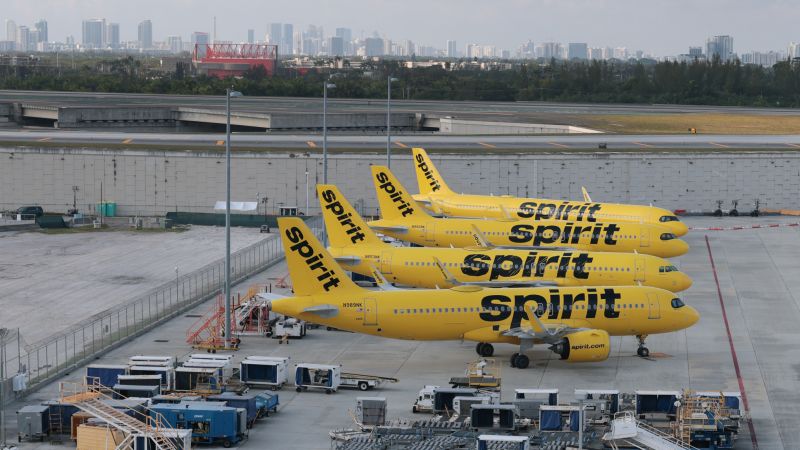
As Spirit Airlines grapples with significant financial distress, its situation has taken a turn for the worse, leading to its second bankruptcy filing in August 2025. The airline’s plight worsened following a conflict with Iran, which exacerbated fuel prices and rendered its financial outlook nearly untenable. This predicament has prompted discussions within the Trump administration regarding a possible $500 million bailout, a move that would effectively place the majority of Spirit’s shares under government control.
President Donald Trump publicly indicated his willingness to consider the bailout, provided that the terms were favorable. He noted the potential value of Spirit’s aircraft and assets, suggesting that with lower oil prices in the future, the government could realize a profit from such an investment.
Despite the administration’s initial optimism, internal divisions quickly surfaced among Trump’s aides. Transportation Secretary Sean Duffy and Commerce Secretary Howard Lutnick advocated for the deal, viewing it as a political victory for the administration. However, others, including Duffy, Trump’s deputy chief of staff Stephen Miller, and National Economic Council Director Kevin Hassett, raised concerns about propping up a company with a troubled financial record. They highlighted that previous bailouts typically benefitted the entire airline industry during crisis events, not individual carriers experiencing operational difficulties due to market changes.
Amidst this turbulent backdrop, Duffy disclosed that he had multiple discussions with Trump, emphasizing the urgency to find a solution. However, as talks progressed, it became apparent that a bailout would involve complexities that were not present in Trump’s prior interventions with companies like U.S. Steel or Intel. The proposal to invoke the Defense Production Act for added control was ultimately rejected by the Department of Defense.
Additionally, Duffy floated the option of Spirit being acquired by another airline, but interest in that proposition proved minimal. By Thursday, the administration signaled to Spirit’s CEO, Dave Davis, that a bailout was unlikely, prompting Duffy and his team to collaborate with competing airlines to devise a plan for the estimated 14,000 employees and customers affected by the situation.
Trump’s comments on Friday suggested a glimmer of hope for the airline’s survival as he confirmed they were still contemplating options. However, despite his optimistic rhetoric, he did not directly engage with the relevant stakeholders as the day progressed. By Friday evening, Spirit began cancelling flights, and by late that night, the company announced the initiation of an orderly wind-down of its operations. Duffy later affirmed that the creditors had not reached an agreement with the government for a bailout, leaving them unable to secure the necessary funding.
In the wake of Spirit’s tragic demise, blame shifted among officials, with some pointing fingers at former Democratic leaders for preventing a merger with JetBlue that could have salvaged the airline. Senator Elizabeth Warren responded to these accusations, underscoring that rising fuel prices, influenced by political conflicts, had ultimately precipitated Spirit’s failure, which was further compounded by the merger’s legal prohibitions.
As Spirit Airlines ceases operations, the consequences ripple through the travel landscape, stranding countless passengers and prompting competing airlines—such as United, Delta, JetBlue, and Southwest—to adjust their pricing strategies to aid displaced customers. The cessation of Spirit’s low-cost flights represents a significant setback for budget-conscious travelers, particularly those reliant on the airline’s minimal-fare services. This situation signals broader implications for air travel accessibility, marking another blow to the working class who depend on affordable options in an increasingly expensive market.