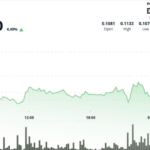
Bitcoin is currently trading above the $80,000 mark for the first time since late January, garnering attention as Asia begins its trading week. Analysts from CryptoQuant highlight that this surge is fueled by buyers who exhibit a cautious approach, a sentiment captured in both positioning data and on-chain indicators.
Recent data reveals that U.S. spot bitcoin exchange-traded funds (ETFs) have experienced strong inflows, accumulating approximately $2.7 billion in just the last three weeks. This has contributed to a rise in total net assets above $100 billion, presenting a substantial source of real-money backing for Bitcoin’s price movement. However, the demand landscape appears uneven, raising questions about the sustainability of this upward trend.
Market maker FlowDesk noted a marked increase in interest for leveraged long positions, especially in major cryptocurrencies such as ether (ETH) and Near Protocol’s NEAR. This trend implies that a fast money mentality might be playing a pivotal role in the upward pressure on Bitcoin prices.
Despite these developments, on-chain metrics indicate that the ongoing rally may not be broadly supported. A report from CryptoQuant revealed that the driving force behind Bitcoin’s price increase in April was a significant rise in perpetual futures demand, while spot demand exhibited signs of contraction over the same period. This divergence—where leveraged positions grow without corresponding increases in spot buying—has historically signified precarious price gains prone to reversal.
Prediction markets also reflect this cautious optimism. On Polymarket, traders assign a 56% probability to Bitcoin reaching $85,000 this month, but only a 23% chance of hitting $90,000. Such probabilities suggest a prevailing expectation for a gradual ascent rather than an explosive breakout.
In summary, while current signals indicate a rally propelled by flows and leverage, the lack of broader conviction raises concerns about the durability of this price rise. Future movements, particularly any slowdown in inflows or shifts in investor positioning, may trigger sharp reversals instead of sustained advancements, mirroring historical patterns in the cryptocurrency market.