In Long Beach, California, Ford Motor Company is steadfast in its commitment to electric vehicles (EVs), even as the automotive industry faces significant challenges in transitioning to all-electric models. Despite substantial losses totaling $19.5 billion associated with restructuring its EV operations, along with a slowdown in EV adoption and the recent removal of U.S. consumer incentives, Ford is betting on its new Universal Electric Vehicle (UEV) platform. CEO Jim Farley has emphasized that these forthcoming EVs are poised to be “industry-defining.”
Alan Clarke, Ford’s EV product leader, underscored the company’s adaptability in confronting various market conditions. Speaking from the recently inaugurated Electric Vehicle Development Center, he highlighted the need for “agility” in the current landscape marked by “massive headwinds.” Clarke, a long-time Tesla veteran who now oversees advanced EV development at Ford, articulated the goal of achieving profitability with the UEV platform by 2029, aiming for new models to turn a profit within a year after their launch.
The first product to emerge from the UEV will be a competitively priced midsize pickup truck, set to retail for around $30,000. Clarke described this vehicle as unique in both cost and design, claiming it will stand out among its competitors. This move aims to transition Ford’s Model E division from incurring significant losses to eventually breaking even.
Despite the departure of key executives, including Doug Field, who was instrumental in Ford’s EV strategy, the company’s project momentum remains intact. Clarke, who was part of Field’s team, expressed confidence in continuing the work initiated by him. Farley has also voiced support for Field, commending his contributions and recognizing the timing of his exit as strategic.
As Ford navigates a competitive landscape—with rising threats from Chinese automotive firms—Farley has called for a level playing field in the U.S. While Clarke acknowledges that Chinese manufacturers operate under different rules, he remains optimistic about the UEV’s ability to compete due to its design centered on affordability and efficiency. He noted the urgency of adopting practices that align with consumer price expectations while meeting competitive benchmarks.
The challenges posed by the rapid pace of Chinese automotive innovation—often able to bring new vehicles to market in a fraction of the time taken by traditional automakers—compel Ford to rethink its strategies. Consulting firms have noted that Chinese companies are reportedly launching new products at an expedited rate, presenting ongoing challenges for their American counterparts.
To counter these competitive pressures, Ford is emphasizing collaboration with other manufacturers around the world, including potential partnerships with established brands in Europe and Asia. The company’s focus remains on the North American market for the immediate future, but Clarke hinted at broader aspirations to offer UEVs globally.
The development of the UEV platform is being seen as a transformative strategy for Ford. With innovations such as smaller battery packs and a streamlined assembly process through techniques like megacasting, Ford aims to lower production costs significantly. This is critical given the company’s acknowledgment of substantial losses in its EV sector, projected to remain between $4 billion and $4.5 billion this fiscal year.
Farley has posited the importance of the UEV platform by drawing parallels to Ford’s historical innovations, suggesting that the project could be as revolutionary as the Model T. Yet, despite the forward-thinking approach and extensive investments in their new facility, past commitments to ambitious projects—including all-electric models that did not meet expectations—raise questions about the company’s future trajectory in the EV landscape.
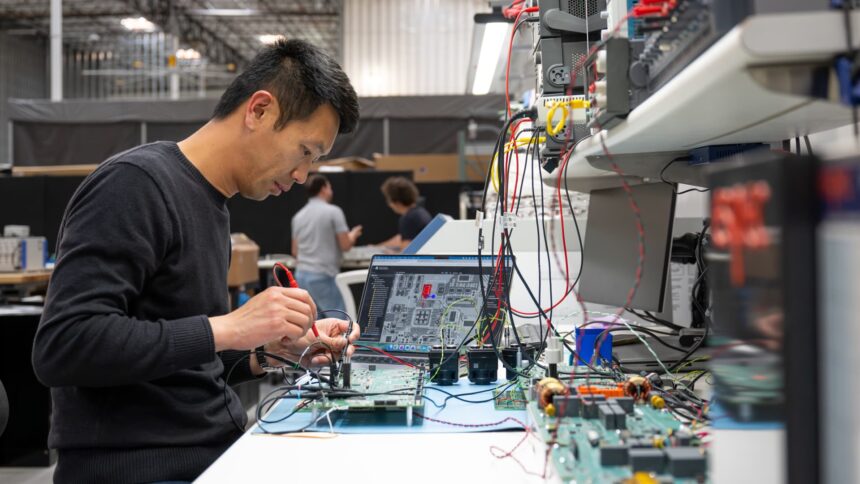
Ford’s innovative campus in Long Beach spans 270,000 square feet and houses around 350 employees from diverse backgrounds, indicating a concerted effort to cultivate a culture more attuned to rapid product development typical of the tech industry. Clarke emphasized the facility’s future-oriented focus, stating that while current developments stem from a previously secretive team, the infrastructure is being set up to accommodate next-generation products.
This investment reflects a broader strategic intent to enhance not only EV offerings but also to integrate cutting-edge innovations across Ford’s entire product line. Clarke expressed hope that this ambitious endeavor would allow Ford to expedite its timeline for new vehicle launches, highlighting a sense of urgency in meeting consumer demands and industry standards.