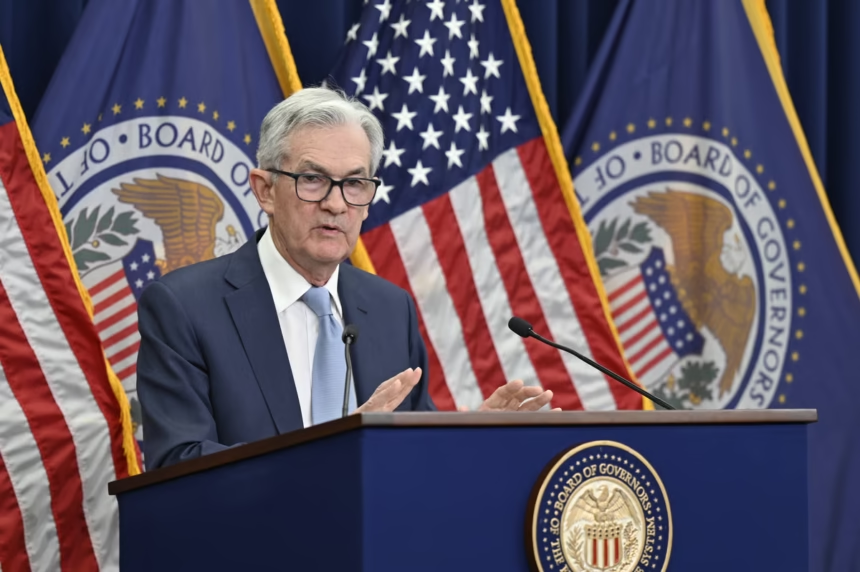
The S&P 500 has seen remarkable gains, more than doubling since the onset of the current bull market in October 2022, and the index is currently hovering near its all-time high. However, looming changes in leadership at the Federal Reserve could present significant challenges for the stock market in the near future, particularly with the potential nomination of Kevin Warsh to replace Jerome Powell as Chair in May.
Recently, the Senate Banking Committee voted to advance Warsh’s nomination to the full Senate, marking a historic moment as the vote occurred entirely along party lines for the first time. Concerns among Democrats center on Warsh’s stance regarding interest rates, particularly his alignment with President Trump, who has vocalized criticisms of Powell for maintaining “too high” rates. This concern is exacerbated by Warsh’s ambition to decrease the Fed’s balance sheet, which could exert upward pressure on interest rates.
During his confirmation hearing in April, Warsh articulated a critique of the Federal Reserve, suggesting that it had strayed from its intended path and advocating for a “regime change” in monetary policy. He contended that the Fed’s balance sheet, currently bloated with about $6.7 trillion in assets—down from $9 trillion in 2022—is a tool that primarily benefits those with financial assets rather than the broader economy. His view emphasizes the interest rate tool as a more equitable means of monetary policy.
Warsh’s perspective is rooted in his belief that quantitative easing, employed during the financial crisis when the economy was unstable, shouldn’t have transformed into a long-term strategy. This unconventional monetary approach involved the Fed buying Treasury bonds and mortgage-backed securities to stabilize financial markets.
The implications of shrinking the Fed’s balance sheet could prove detrimental to the stock market in multiple ways. If the Fed reduces its holdings, there could be a decline in bond prices and a corresponding increase in yields. Such a scenario would have several ripple effects:
-
Increased Borrowing Costs: Companies may face higher costs for borrowing, which could limit their capacity to invest in growth, ultimately hindering earnings growth.
-
Shift in Investment Preferences: Higher yields on bonds might make them more attractive compared to stocks, prompting investors to reallocate their portfolios away from equities.
-
Reduced Liquidity: Diminishing the Fed’s balance sheet would decrease liquidity in the financial system, potentially leading to lower institutional demand for equities.
Furthermore, stock valuations are often assessed based on discounted future cash flows, an equation that typically utilizes the yield on 10-year Treasury bonds as a baseline. If yields rise, the discount rate must also rise to offset the increased risk associated with alternative investments, thereby diminishing the present value of anticipated future earnings. This could lead to compression in price-to-earnings multiples, particularly concerning since the S&P 500 is currently priced at 20.9 times forward earnings—above the historical average of 18.9 times.
In summary, while the stock market appears expensive by historical metrics, the existing premium may be justified if interest rates continue their downward trajectory. However, if Kevin Warsh’s appointment leads to a contraction of the Fed’s balance sheet, upward pressure on interest rates could not only undermine those valuations but also compel the market to realign, potentially resulting in a decline for the S&P 500.