The stock markets in Asia have recently experienced remarkable recoveries, reaching new heights despite ongoing challenges stemming from the conflict in Iran. This resurgence has followed a significant downturn in March, showcasing resilience in regions heavily reliant on oil imports.
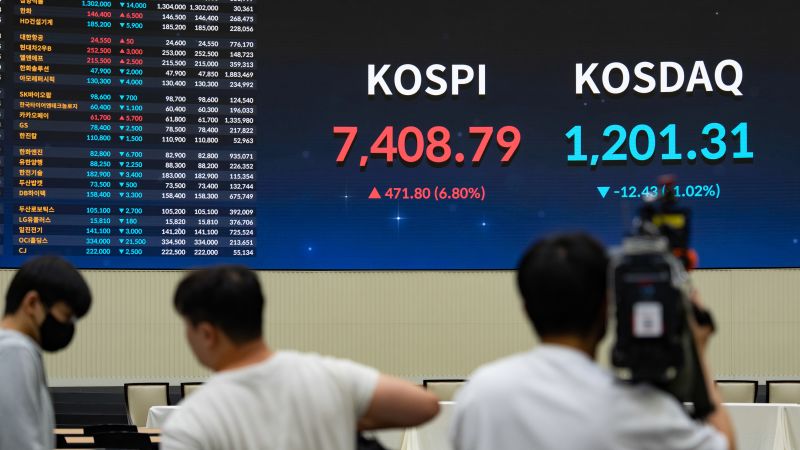
Taiwan, South Korea, and Japan have all recorded impressive gains, with the Kospi index of South Korea and Taiwan’s Taiex both achieving record highs in recent trading sessions. Japan’s Nikkei 225 index also reached a record high the previous week. This surge is mirrored by gains in the US markets, where the S&P 500 and Nasdaq Composite also hit new highs.
The driving force behind this market enthusiasm appears to be the global boom in artificial intelligence (AI). The AI-driven rally has managed to overshadow the economic risks associated with the ongoing conflict in the Middle East. The demand for semiconductor chips, crucial for establishing AI infrastructure, has particularly benefited Asian markets, positioning them advantageously amidst a complicated geopolitical landscape.
While Europe has struggled to keep pace with these impressive gains, countries in Asia have displayed potential tailwinds due to their exposure to the AI capital expenditure cycle. Morgan Stanley’s head of market research, Daniel Skelly, noted that much like the US, much of Asia stands to gain from the upsurge in AI-related investments.
Despite the troubling situation with escalating oil prices—a challenge especially pronounced for net-energy importers like Japan and South Korea—the market has remained buoyant. South Korea’s Kospi index soared by nearly 76% in 2025, marking its best performance since 1999, and is already up 75% in the current year. The equity market’s growth propelled it to surpass Canada, becoming the world’s seventh-largest market.
Significantly, Samsung Electronics has seen a remarkable rise, crossing the $1 trillion mark in market value, making it the second Asian company after Taiwan Semiconductor Manufacturing Company to achieve this milestone. Taiwan’s Taiex index is also flourishing, having risen 16% since the onset of the conflict and up 42% this year, allowing Taiwan to emerge as the world’s sixth-largest stock market.
Positive investor sentiment regarding potential peace efforts, combined with momentum from semiconductor advancements, has contributed to this surge. The abrupt closure of the Strait of Hormuz in March had previously led to a sharp decline in Japan’s Nikkei 225, which fell 13% by the end of March but has since rebounded, demonstrating resilience amid broader geopolitical uncertainties.
The index is now up 1% since the beginning of the war and shows an overall increase of 18% for the year. Analysts have indicated that savvy investors are gravitating towards sectors capable of delivering substantial earnings. AI-related ecosystems and technology companies are positioned as strong performers, signaling a clear shift in market dynamics.
In contrast, European markets have continued to languish below pre-war levels, suffering from a lack of tech and AI-focused companies. Germany’s Dax remains down over 1% since the conflict began, while Europe’s benchmark STOXX 600 index has also seen declines, reflecting the region’s struggles in harnessing the technological advancements impacting markets elsewhere.
In South America, energy-exporting nations like Brazil have witnessed some benefits from higher oil prices, maintaining a relatively stable Bovespa Index since the conflict commenced, alongside a 16% increase for the year.
Analysts have pointed out that while Asia leans on AI for growth, Latin America finds its strength in energy resources, and Europe faces challenges with both sectors. This divergence underscores the complex interplay of global markets in the face of geopolitical issues and technological advancements.