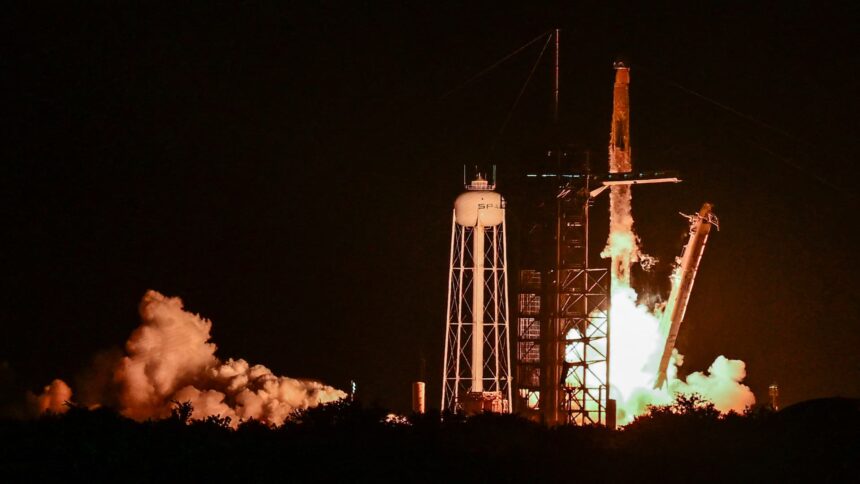
Elon Musk’s SpaceX is set to make headlines with plans for what could be the largest stock debut in history. While the focus is on Musk’s venture, an unexpected beneficiary is an industrial gases giant named Linde—a company with a rich history that predates the Wright brothers.
Linde, which has operated for over 140 years, manufactures essential gases for the aerospace sector. These gases are crucial for rocket propulsion and the functioning of satellites, playing a vital role from the testing phase of spacecraft components to their actual launches. The company has been instrumental in various high-profile missions, including NASA’s Apollo program and the current Artemis II moon mission.
As the commercial space race accelerates, SpaceX stands out as an industry leader among new entrants. In anticipation of increased demand, Linde is investing $100 million to establish a new plant in Texas, strategically located near SpaceX’s operations. This facility is expected to enhance the delivery of the gases critical for rocket launches.
Although Linde may not be a household name, its market capitalization is nearly $230 billion, and it has supplied industrial gases for over a century. Their products, including carbon dioxide, oxygen, and nitrogen, are utilized across a wide range of sectors—from creating bubbles in soft drinks to providing life-saving respiratory support in hospitals.
The implications of SpaceX’s IPO are substantial. The company recently filed for an IPO that could raise up to $75 billion, targeting a valuation around $1.75 trillion, significantly larger than the market cap of Meta Platforms. With plans for a late June listing, the influx of cash from the IPO could fuel SpaceX’s ambitions, including expanding its Starlink satellite internet service and pursuing human travel to Mars.
The correlation between SpaceX’s launch frequency and Linde’s gas supply is notable. Deutsche Bank analyst David Begleiter likened Linde to “the Exxon for space,” projecting that SpaceX’s IPO could potentially double the size of Linde’s aerospace business, pushing it beyond $1 billion.
Musk has indicated that SpaceX plans to ramp up its launch activities, particularly with its fully reusable Starship rocket. During recent discussions, he suggested that in a few years, there could be days with 24 Starship launches, highlighting the escalating demand for rocket launches.
Linde has prepared for this growth, securing long-term contracts with space clients and investing in increased production capabilities. Its new air separation plant in Brownsville, Texas, is specifically designed to support SpaceX’s Starbase operations, while a facility in Mims, Florida, will further bolster its capabilities, given its proximity to NASA’s Kennedy Space Center.
Positioning itself as a crucial supplier, Linde is instrumental in various stages of rocket operations. From liquid oxygen used for combustion to gases that maintain engine temperatures, the company’s products play a significant role during launches and component testing. Linde’s expansion into the space sector is expected to fuel long-term growth, with the company supplying gases to an estimated 65% to 75% of launches.
Founded in 1879 by Carl von Linde, the company has been at the forefront of the industrial gas sector since its inception. Its pioneering work in air separation technology allowed for the production of liquid oxygen—a critical element for space travel. Linde’s history seamlessly aligns with the evolution of the aerospace industry, including its contributions to NASA’s Apollo missions and recent Artemis missions.
As the space industry enters a new investment phase, characterized by significant capital inflows, Linde’s trajectory looks promising. The surge in funding supports increased launch frequencies and the growing number of commercial partners for government projects.
This new era heralds a transformative period for both SpaceX and Linde. The anticipated IPO could trigger a wave of new public listings in the space sector, reinforcing confidence in this burgeoning market.
Overall, Linde’s measured growth strategy and its role in the space industry signal an enduring opportunity for the company, despite other sectors being more dominant in its revenue streams. With consistent capital management and a robust executive team, Linde remains well-positioned to capitalize on the expansion of the aerospace market, proving itself to be a silent but powerful player in the industry.