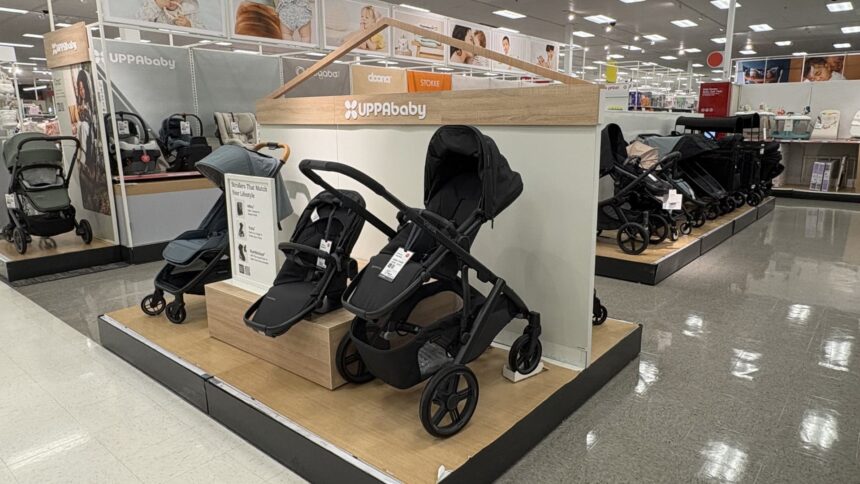
CLIFTON, New Jersey — Shoppers at select Target locations will now discover a new shopping experience designed specifically for families, especially those with young children. Target has introduced “baby boutiques” within approximately 200 of its stores, allowing parents to examine and try out baby products like strollers, car seats, and high chairs in person rather than relying solely on packaging information.
This initiative includes offerings from premium brands such as UPPAbaby and Stokke, featuring high-ticket items like a $1,000 UPPAbaby stroller. Overall, nearly 2,000 new baby products are now available both in stores and online, marking a substantial investment from the retailer to revamp its baby department.
Chief Merchandising Officer Cara Sylvester highlighted the importance of capturing the busy family demographic, noting that families with children aged 5 and under typically spend twice as much as the average customer. She emphasized that busy families tend to consolidate their shopping to fewer places, making it essential for Target to cater to their needs effectively.
As part of a broader strategy to rejuvenate the brand, these “baby boutiques” reflect a commitment to improve product quality, enhance the shopping experience, and offer convenient services such as same-day pickup and delivery. This push comes amid challenges to Target’s market position, including stiff competition from Walmart and Amazon, as well as potential financial constraints on customers due to rising gas prices.
Despite a decline in overall customer traffic across Target’s locations for the past four quarters, there are indications of a resurgence in store visits, according to analysis by Placer.ai. Target is optimistic about recent changes aiding in a return to annual sales growth, projecting a 2% rise in net sales year-over-year.
Target’s decision to refresh its baby department, the largest investment in that sector in over a decade, may seem counterintuitive given the declining birth rate in the U.S., which has dropped roughly 16% since 2007. Nonetheless, research indicates that parents are more likely to frequent stores less frequently but make larger purchases, highlighting the long-term significance of attracting those customers.
Although Target currently holds 17.6% of the U.S. baby market share, it has seen a decline from 18.6% over the past two years, while competitors Walmart and Amazon have increased their shares. The retailer aims to reclaim its position by enhancing the shopping experience.
Target’s “baby boutiques” feature an inviting layout, allowing for hands-on interaction with products. Customers can test popular items from brands like Bugaboo and Doona and engage with Target’s own Cloud Island brand, which offers an array of baby essentials. Additionally, Target is piloting a baby concierge service through Tot Squad to assist customers with product comparisons and baby registries, available in-person at these boutiques and online.
The shift comes in response to market trends where parents are inundated with choices but seek efficiency in their shopping experience. Addressing the frustrations of overwhelmed consumers, Target aims to position itself as a destination for both reasonable prices and a more curated, premium experience.
In a recent presentation, Sylvester candidly acknowledged Target’s struggles in attracting and retaining family customers in the past few years. However, she articulated optimism about reconnecting with parents, viewing the revamped baby department as a critical stepping stone to boosting sales across all categories, given the lifetime value of new parents.
Overall, the launch of the baby boutiques demonstrates Target’s commitment to an evolving retail strategy designed to foster loyalty among busy families during a transformative time.