An early copy of Ben Carlson’s new book, “Risk & Reward,” has generated considerable enthusiasm among readers and investors alike. Scheduled to hit shelves on May 12, Carlson brings his unique blend of entertainment and insight into the often-intimidating world of investing. He is known for his engaging writing style, which makes complex topics more accessible while simultaneously enhancing the reader’s financial literacy.
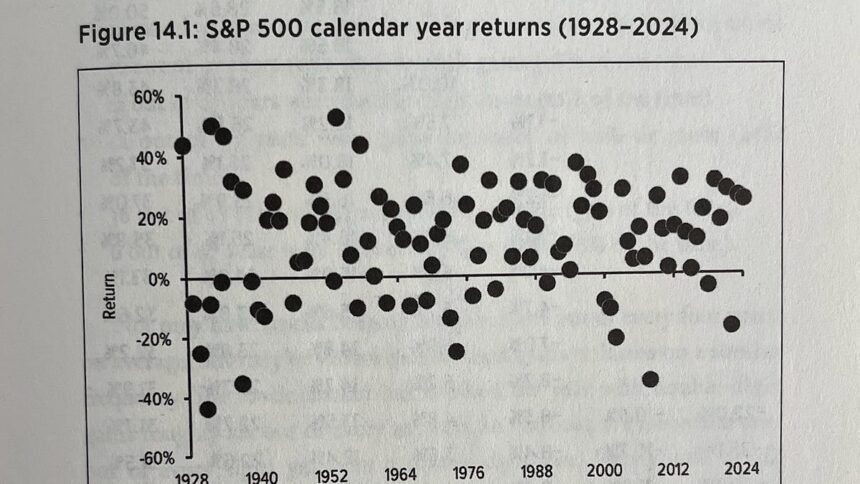
The book is filled with informative charts and visuals, including a particularly striking representation of the S&P 500’s annual returns since 1928. This chart showcases the erratic nature of stock market performance, which may surprise many traders familiar with the common narrative of steady returns averaging between 8% and 10%. Carlson emphasizes that while these averages hold true over longer periods, the actual annual returns are anything but predictable. He points out that it is not uncommon to witness years of consecutive losses or gains, highlighting these fluctuations as a fundamental part of investing.
Carlson stresses the need for investors to recalibrate their expectations, especially those who may feel anxious about market volatility. He argues that the notion of achieving an average return in a typical year is misleading, noting that historical data reveals average years are exceedingly rare. He encourages prospective investors to look beyond mere numbers and manage their expectations based on a broader understanding of market behavior.
In addition to insightful commentary on stock market dynamics, Carlson’s work draws attention to recent data points that reflect current economic conditions. For instance, the S&P 500 recently rallied to all-time highs, with an upward trajectory of 8.1% year-to-date. The labor market also reflects mixed signals, with the U.S. adding 115,000 jobs in April and the unemployment rate holding steady at 4.3%. Wage growth appears to be cooling, although job switchers still enjoy higher pay compared to those who stay in their roles.
Despite a slight dip in job openings and a reduction in consumer sentiment, where concerns about rising prices have become prevalent, other indicators point to a resilient economic landscape. For example, business investment activity has surged, with an increase of 3.4% in orders for nondefense capital goods. Additionally, construction spending has also seen an uptick, alongside a rebound in new home sales.
However, the turbulent nature of economic indicators continues to pose challenges, with elevated gas prices stressing household budgets and influencing consumer behavior. The national average for gasoline has risen sharply, leading to increasingly negative consumer sentiment.
As economic conditions fluctuate, Carlson’s insights serve as a reminder that while the stock market might reflect broader economic trends, it consistently offers opportunities for long-term investors willing to weather short-term uncertainty. His book aims to equip readers with better tools for understanding market dynamics, emphasizing the importance of looking beyond immediate returns.
The investment landscape is ever-evolving, filled with both challenges and opportunities. Readers eager to navigate these complexities would do well to explore Carlson’s latest offering to sharpen their understanding of risk and reward in investing.