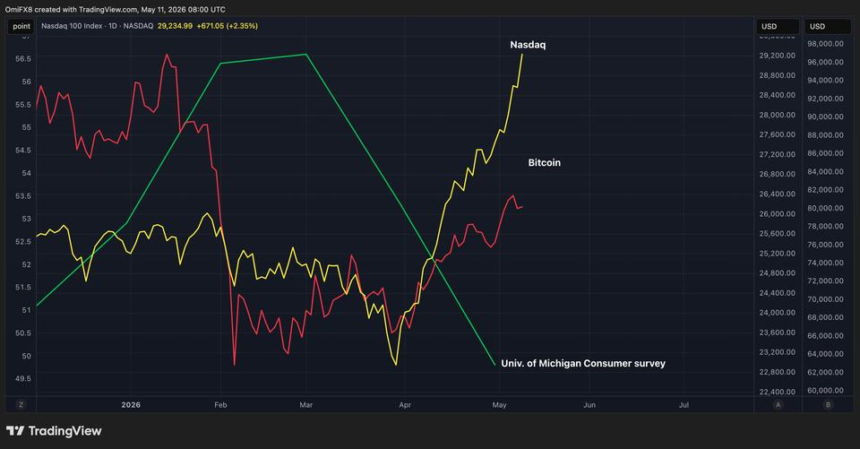
Major financial assets and the sentiment of the American consumer are diverging sharply, revealing contrasting narratives about the current state of the U.S. economy. Recent data reveals that Bitcoin, the foremost cryptocurrency, surged by 11.8% last month—its most significant increase since April 2025—and it has extended this upward trajectory with an additional 6% rise, elevating its value to approximately $80,700, according to CoinDesk data.
This cryptocurrency boom is occurring alongside a robust performance on Wall Street, particularly highlighted by the tech-heavy Nasdaq index, which has experienced a phenomenal increase of 22% since April 1, reaching a record high of 23,235 points. The broader S&P 500 index also saw substantial gains, climbing over 12% to 7,398 points, as reported by TradingView.
Historically, such rallies in stocks and cryptocurrencies tend to uplift consumer sentiment, particularly as around 30% of American adults—approximately 70.4 million people—own some form of cryptocurrency. Moreover, data indicates that an average of 62% of adults have owned stocks at some point in 2023.
Contrary to this expected optimism, recent findings from the University of Michigan’s consumer survey revealed a troubling picture. The preliminary reading of consumer sentiment hit a record low of 48.2 points, marking a decline of 7.7% year-over-year and extending the downward trend from April’s reading of 49.8 points. The survey highlighted that one-third of respondents identified rising gas prices as their primary concern, while another third pointed to tariffs as a significant issue.
Alvin Kan, COO of Bitget Wallet, emphasizes the stark contrast between Wall Street’s exuberance and the struggles faced by the average consumer. He noted that while institutional money is flowing into sectors like artificial intelligence, semiconductors, and digital assets—driving markets higher—consumer confidence is faltering as households grapple with persistent inflation and escalating living costs. “Markets are trading the future while consumers are still focused on present-day financial pressure,” he remarked.
The momentum driving the Nasdaq’s rise has been attributed to strong corporate earnings from major technology firms and an accompanying boom in artificial intelligence capital expenditures, which concurrently have been fueling interest in cryptocurrencies like Bitcoin. The influx of billions into U.S.-listed spot ETFs amid this market rally underscores the evolving landscape for digital assets, according to Kan.
Crypto and equity markets have been growing increasingly intertwined, particularly following the institutional acceptance of Bitcoin. This correlation indicates a shift from cryptocurrency’s origins as a grassroots financial movement to a position more aligned with institutional market dynamics. Markus Thielen, founder of 10x Research, commented on this evolution, stating that the initial promise of financial democratization within crypto has diminished; wealth concentration has intensified, particularly evident in the stock market, where gains benefit an increasingly affluent few.
Looking ahead, the widening gap between consumer sentiment and market performance raises intriguing questions about the future trajectory of both sectors. Gracy Chen, CEO of Bitget, anticipates that this divergence will continue. She pointed out that digital assets are now drawing in capital in search of superior returns, reinforcing their role as vital tools for diversification and risk management in volatile market conditions. While various risks—including tightening monetary policies, geopolitical tensions, and shifting regulatory landscapes—could exert additional pressure in the near term, she remains optimistic about the maturation and structural growth potential of the emerging crypto ecosystem.