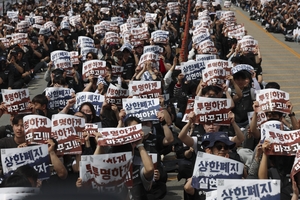
In a significant shift within South Korea’s corporate landscape, unions across multiple sectors are increasingly advocating for profit-linked performance payouts, reminiscent of a recent agreement at SK hynix. The trend has gained momentum beyond the semiconductor industry, now encompassing the automotive, telecommunications, and digital services sectors.
The latest development comes from Kakao Corp., the leading messaging platform in the country. The Kakao union filed for state mediation after wage negotiations stalled, joining calls for compensation structures that tie performance bonuses to a fixed percentage of operating profits. This request was formally put forth to the Gyeonggi Regional Labor Relations Commission and includes members from Kakao Pay, Kakao Enterprise, and another affiliate. While the union did not specify an exact percent, estimates suggest their demand would equate to approximately 13 to 15 percent of last year’s operating profit, potentially translating to around 15 million won per employee based on projected figures for 2025.
Kakao representatives stated that they had engaged in negotiations with the union in good faith but could not reach an agreement concerning the specifics of the compensation structure. They committed to cooperating with the mediation process.
This call for substantial profit-sharing is not isolated. Samsung Electronics’ largest union is also pushing for a 15 percent share of its chip division’s operating profit and has planned an 18-day strike scheduled to commence on May 21. Meanwhile, Hyundai Motor’s union has demanded an even more ambitious 30 percent of the company’s anticipated net profit for 2025, which could amount to over 3 trillion won. Similarly, the union at LG Uplus has proposed a bonus equaling 30 percent of operating profit along with an 8 percent wage increase and a reduction in the workweek to 35 hours.
The driving force behind these demands can be traced back to a landmark agreement reached in 2025 by the SK hynix union, which stipulated that 10 percent of annual operating profit would be allocated as bonuses, alongside the elimination of a previous cap on bonuses. The outcome of this agreement has been dramatic, with the company reporting a bonus payout in early 2026 equivalent to over 2,900 percent of base pay—an average of more than 100 million won per employee.
However, the environment for these demands is fraught with challenges. Companies are facing varying degrees of profitability and market volatility. For instance, Kakao’s stock has dropped significantly over the past year, while Hyundai reported a year-on-year decline of 30.8 percent in its first-quarter operating profit. These financial pressures complicate the unions’ aspirations for high-performance payouts.
Experts warn that this trend, while emerging from notable success at SK hynix, may be setting unrealistic expectations across several industries where overall earnings are not as robust. As these negotiations unfold, they pose a formidable risk to corporate profitability, particularly for firms heavily investing in future technologies. Samsung, for example, is dedicating immense capital to develop advanced high-bandwidth memory and innovative packaging solutions, and the demands of its union could see a substantial reduction in its operating profits.
As unions and managements engage in intense negotiations, company leaders must navigate these demanding circumstances with a clear understanding of both employee sentiment and the financial landscapes they operate within. The unfolding situation signifies not only a shift in labor relations but also a critical moment for corporate strategy in South Korea.