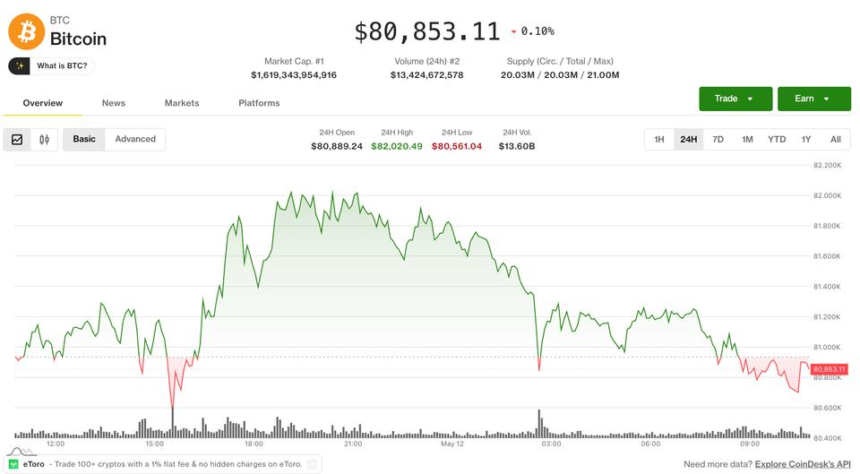
The broader cryptocurrency market experienced a downturn on Tuesday, with Bitcoin (BTC) slipping 1% since midnight UTC to trade at approximately $80,800. Ethereum (ETH), the second-largest cryptocurrency, saw a more significant decline of 2%, settling at around $2,290. This dip coincided with falling U.S. equity futures, following comments from former U.S. President Donald Trump, who described the ceasefire with Iran as “on massive life support.” This political uncertainty contributed to a spike in Brent crude oil prices, which hit $107 per barrel, and a 0.4% uptick in the U.S. Dollar Index (DXY).
Despite these losses, Bitcoin remains above a crucial threshold set by Bitmine (BMNR) Chairman Tom Lee, who indicated that holding above $76,000 at the end of the month would signify the end of the current bull market. The altcoin market showed a mixed performance, with most tokens underperforming Bitcoin and Ethereum. However, select altcoins such as CRO ($0.08090), Curve (CRV), and Toncoin (TON) managed to defy the broader trend, posting gains between 5% and 10% over the past 24 hours.
In terms of derivatives, the notional open interest (OI) in crypto futures increased to $125 billion, although trading volumes dropped by 6% to $174 million. This juxtaposition suggests a decrease in short-term speculation as traders reposition themselves. Zcash (ZEC) saw its OI plummet by over 10%, from 2.48 million tokens—the highest in four and a half months—to 1.90 million tokens. This sharp decline contributed to a price drop for ZEC, which fell to $550 from $642, indicating a potential unwinding of bullish bets.
Further declines were observed in the open interest of tokens such as SUI, CORE, and HBAR. Conversely, open interest in Canton’s CC token surged more than 10%, backed by positive funding rates and a favorable 24-hour cumulative volume delta, signaling strong buyer interest. Notable gainers in OI included Ethereum (ETH) and Monero (XMR), although their cumulative volume deltas were negative, suggesting that sellers were driving recent price movements.
The decline in Bitcoin’s 30-day implied volatility index (BVIV) has stabilized around 40% this month, showing no signs of significant upward movement. This level of stability points to a continued calm in the market, which may be conducive to further bullish trends. On Wall Street, the volatility gauge, the VIX, which monitors the S&P 500’s implied volatility, has increased over 10% this week, nearing 19 points. Although still below recent peaks exceeding 30, this uptick has drawn attention from traders.
On the Deribit exchange, the ranking for 24-hour volume highlighted BTC call options with strikes at $80,000, $82,000, and $84,000, indicating a bullish outlook by traders anticipating a price rally. This was paired with put options indicating bearish bets at strikes of $65,000 and $74,000.
Across the board, CoinDesk benchmarks showed declines, with the DeFi Select Index (DFX) leading the losses with a 2.7% drop, followed closely by the CoinDesk Computing Select Index (CPUS), which decreased by 2.3%. Among the day’s poorest performers were altcoins such as JUP, MON, and SEI, which fell between 5.6% and 6.3% due to ongoing liquidity issues. On the upside, CRO’s 4.1% gain marked the token’s third consecutive day of increases, attributed to a governance proposal that—if approved—would amend the project’s tokenomics to shift from inflation-driven staking rewards to a system based on actual protocol revenues.
CoinMarketCap’s “Altcoin Season” indicator has now reached a score of 50 out of 100, the highest since late March, suggesting a positive shift in sentiment across the altcoin sector.