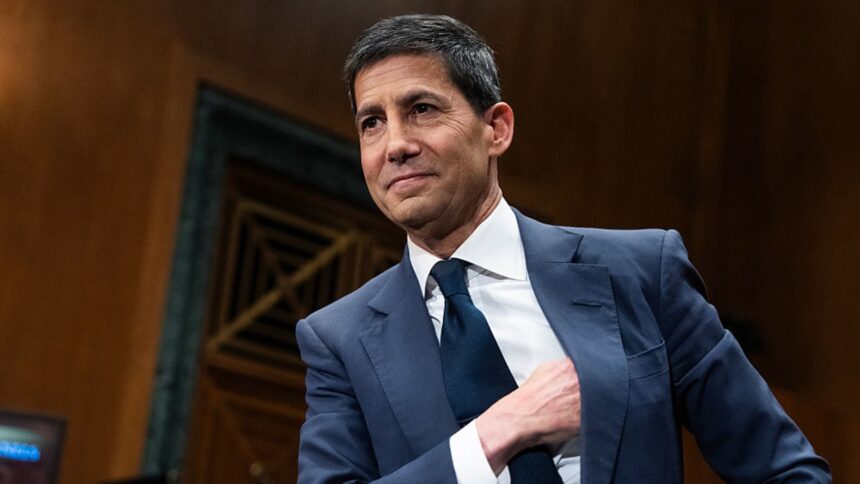
Kevin Warsh has officially been confirmed as the next chair of the Federal Reserve, stepping into the role during a period marked by President Donald Trump’s push for lower interest rates amid rising inflation. The Senate confirmation, which took place on Wednesday, resulted in a narrow 54-45 vote, the most divisive in the history of Fed chair confirmations. Warsh, 56, will replace Jerome Powell, whose leadership has spanned since 2018 and concludes as his term expires this Friday.
The voting breakdown mirrored party lines, with only Pennsylvania Senator John Fetterman straying from the Democratic party to support Warsh. This confirmation caps off a months-long search for Powell’s successor, initiated in the summer of 2025. While Powell will remain at the Fed for at least two more years as a Governor, marking a rare instance where a former Fed chair continues on the board, he has indicated his intention to stay until renovations at the Fed’s headquarters are finalized.
Trump has publicly expressed his expectation that Warsh will implement rate cuts, criticizing Powell for what he perceives as overly restrictive monetary policy. Warsh emerged from a competitive field of candidates that initially included several current Fed governors.
Complicating the economic landscape, recent reports indicate inflation remains significantly higher than the Fed’s 2% target and pipeline pressures have surged to their highest levels in over three years, leading to a reassessment among market expectations regarding interest rate cuts—some are even anticipating a rate hike later this year.
Representative French Hill, a Republican from Arkansas, commended Warsh for his approach to tackling inflation. He highlighted Warsh’s commitment to prioritizing affordability and price stability within the economic strategy. “Chairman Warsh has repeatedly emphasized the importance of placing affordability and price stability at the center of our economic agenda,” Hill stated, emphasizing confidence in Warsh’s monetary policies to foster enduring economic prosperity.
Warsh’s return to the Fed marks his second term; he initially served from 2006 to 2011 and was part of the Federal Reserve’s response to the global financial crisis, a time where initial warnings about the subprime mortgage crisis were overlooked, followed by the execution of aggressive policies such as quantitative easing. Warsh has since criticized certain monetary policies and advocated for significant change within the institution, including a notable call for “regime change” in a CNBC interview last year.
He will fill the position vacated by Stephen Miran, who served briefly after being appointed in September 2025 following the unexpected resignation of Adriana Kugler. Notably, Miran has consistently opposed the Federal Open Market Committee’s recent decisions, advocating for larger cuts amidst a climate of cautious monetary policy.
Warsh’s first meeting as chair of the Federal Open Market Committee is scheduled for mid-June. His wealth, reportedly exceeding $100 million, positions him as the wealthiest Fed chair in history; however, he will need to divest many investments due to stringent new rules implemented in the wake of recent controversies surrounding personal trading practices among Fed officials.