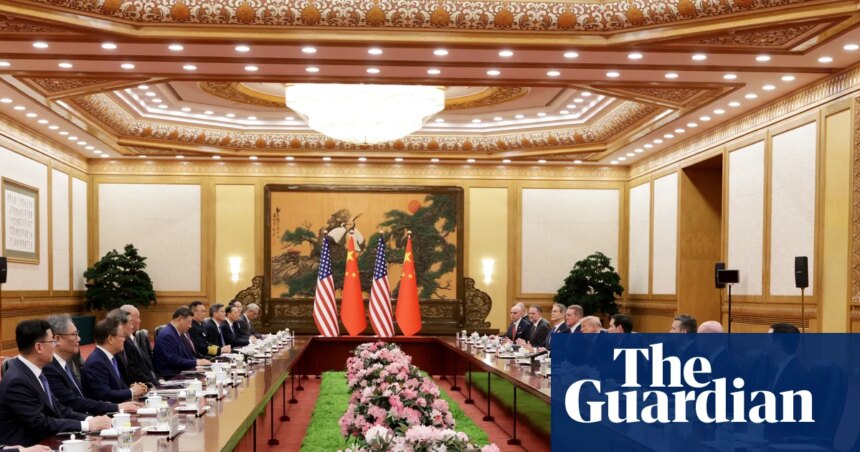
During the highly anticipated meeting between Donald Trump and Xi Jinping at Beijing’s Great Hall of the People, the event was characterized by an impressive display of ceremonial grandeur. The occasion included an elaborate presentation featuring Chinese soldiers, children waving both American and Chinese flags, and an assembly of high-ranking officials and top business leaders from the United States. However, the gathering quickly drew attention for a notable absence: women from either delegation were completely excluded from the table, sparking critiques from various observers.
Prominent economist Gita Gopinath, a professor at Harvard University, took to Twitter to express her concern, stating, “A painting of the end of meritocracy: A meeting of the two largest economies and not one woman at the table.” Her comment resonated widely, garnering over 22,000 likes within hours. In a subsequent interview with the Guardian, Gopinath elaborated on her statement, pointing out that the lack of female representation underscores a troubling shift back towards valuing connections over merit. “It’s just inexplicable how you end up with a single-gender table, given the many talented women around the world,” she remarked.
Halima Kazem, an associate director at Stanford University’s program in feminist, gender, and sexuality studies, echoed Gopinath’s sentiments. She compared the current meeting to past US-China summits during Barack Obama’s presidency, which were marked by the presence of women such as Liu Yandong, then China’s vice-premier, and Susan Rice, the US national security adviser. Kazem noted that the visual of an all-male table is a regression, indicating that neither superpower believes women belong in the spaces where significant power discussions occur. This observation, according to her, sends a concerning bilateral signal regarding the value placed on women’s contributions to global diplomacy.
Kazem further explained the implications of the absence of women at the meeting. “This wasn’t about lack of qualified women – both countries have plenty in their diplomatic and security establishments. This was a choice about what kind of authority to project: masculine, militarized, and exclusionary,” she stated. By presenting power in this manner, both nations are collectively defining the norms of serious diplomacy, effectively sidelining women from critical discussions.
Despite the notable absence of women at the main table, a few women did accompany Trump during his visit to Beijing. Among them were Lara Trump, his daughter-in-law, Citigroup CEO Jane Fraser, and Dina Powell McCormick, president of Meta. Nonetheless, these representatives were not part of the core discussions, raising further questions about the representation of women in high-stakes diplomatic settings. As the dialogue surrounding gender equity continues to grow, the implications of this meeting may linger, prompting ongoing discussions about the role of women in global leadership and diplomacy.