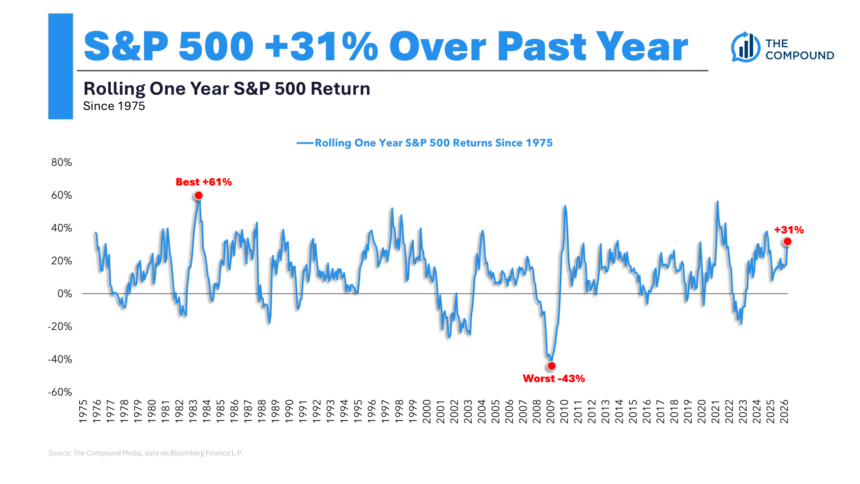
A recent reader inquiry delved into the impressive annual return of 30.6% for the S&P 500, prompting an exploration into whether this number ranks among the historical highs. While the figure is certainly significant—ranking within the top 10 performances since 1975—it’s not unprecedented. Historical analysis reveals that the last year’s uptick ultimately ranks as the 7th or 8th largest in a span of nearly five decades.
In examining data from 1975 onward, the S&P 500 has averaged a solid annual return of 12.5%. To put that into perspective, a $10,000 investment made at the beginning of 1975 would have appreciated to a staggering $4.2 million today, showcasing the power of compound growth.
The inquiry specifically focused on the one-year rolling returns of the S&P 500, which recently showcased a growth of 31%. This figure, while impressive, is eclipsed by the highest recorded one-year return of 61% in the early 1980s, following a period of economic turmoil. That surge marked the beginning of a long bull market, catalyzed by Federal Reserve policies aimed at curbing rampant inflation. Conversely, the most challenging period recorded was during the Great Financial Crisis, when the index suffered a 43% decline in a single year.
In terms of return distribution, the recent 31% gain places it in the 88th percentile of one-year returns since 1975. Historical data reveals that returns of 40% or greater occurred 22 times, while 50% increases were seen only seven times. Furthermore, in about 17% of one-year periods, the market experienced losses; double-digit declines were observed in 8% of cases, with 20% losses recorded in just 3%.
Looking ahead, the big question is what the stock market might do following such a robust year. Past trends indicate that after gaining 30% or more in a year, the average return over the subsequent 12 months is around 11.1%. This uncertainty reflects the unpredictable nature of the market, where potential factors—like AI-driven earnings growth—may already be priced in.
In a related discussion featured on a recent episode of “Ask the Compound,” financial expert Bill Sweet addressed a variety of topics, including the reasons behind the current stock market surge and practical advice on tax management and planning for future expenses such as college and retirement.
As always, investors are reminded that market conditions can shift rapidly, and past performance is not indicative of future results. Individuals are encouraged to consult their financial advisors to navigate the complexities of investment decisions effectively.