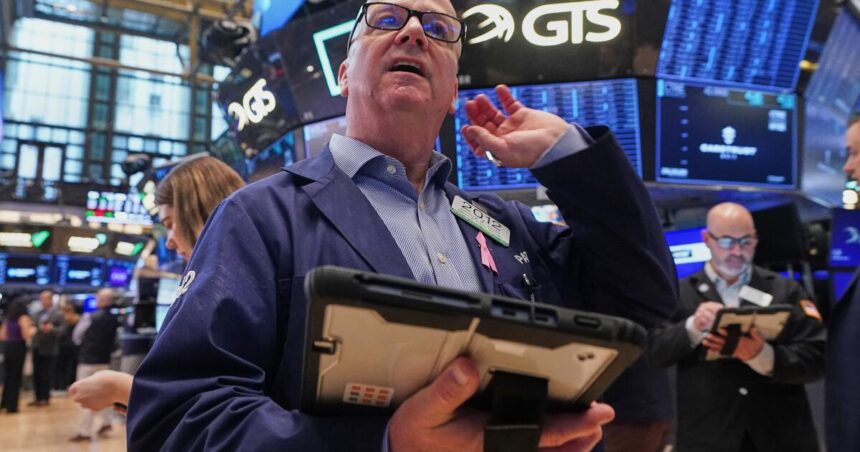
The stock market faced a significant downturn on Friday, mirroring a global slide in equities. This decline was spurred by escalating oil prices, which unsettled the bond market and particularly affected stocks closely linked to the recent enthusiasm surrounding artificial intelligence (AI) technologies.
The Standard & Poor’s 500 index declined by 1.2%, moving away from its all-time high set just the day before. The Dow Jones Industrial Average suffered a more substantial drop, losing 537 points, or 1.1%. The Nasdaq composite dropped 1.5%, losing ground from its record as well.
Technology stocks, which had been major contributors to market gains earlier this year, experienced sharp declines. Nvidia, a leading player in the AI sector, fell by 4.4%, making it the largest drag on the S&P 500. Despite this drop, Nvidia’s year-to-date performance still shows a remarkable increase of over 26%. Similarly, Micron Technology saw a 6.6% decline, although its year-to-date rise remains impressive at nearly 154%.
Analysts highlighted that the market had likely entered overbought territory. Brian Jacobsen, chief economic strategist at Annex Wealth Management, noted that while strong corporate profits and a resilient U.S. economy have helped stocks soar to record levels, the market’s path forward is expected to be volatile. “Periods like this call for discipline more than hope,” he stated.
This volatility was compounded by the rise in oil prices, which are influencing inflation rates more dramatically than economists had anticipated. Ongoing tensions in the Middle East, particularly the conflict involving Iran, have significantly restricted oil tanker access via the Strait of Hormuz, contributing to higher crude prices. Brent crude oil surged by 3.3% to settle at $109.26 per barrel, markedly up from approximately $70 before the onset of the war.
Despite some large U.S. companies reporting that consumer spending has remained steady even in the face of rising gas prices, surveys indicated growing consumer apprehension about economic conditions. In the bond market, these concerns became evident as Treasury yields increased sharply. The yield on the 10-year Treasury rose to 4.59%, up from 4.47%, and significantly higher than the 3.97% seen prior to the conflict. The 30-year Treasury yield climbed to 5.13%, reaching levels not observed since before the 2008 financial crisis.
Higher yields typically translate to increased borrowing costs for households and businesses, which can stifle economic growth and exert downward pressure on stock prices. Smaller companies, particularly vulnerable to these rising costs, saw substantial declines. The Russell 2000 index, which tracks small-cap stocks, fell by 2.4%, double the drop experienced by the S&P 500.
Overall, the S&P 500 decreased by 92.74 points, closing at 7,408.50; the Dow Jones industrial average fell by 537.29 points to 49,526.17; and the Nasdaq composite closed down by 410.08 points, landing at 26,225.14.
The recent climb in yields has been linked to concerns about how inflation may restrict the Federal Reserve’s ability to manage interest rates. Market participants have largely abandoned hopes for interest rate cuts in the near future and are contemplating potential rate hikes as far ahead as 2026, driven by encouraging economic reports. Data indicating stronger-than-anticipated industrial production and accelerated manufacturing growth in New York were instrumental in this shift.
Internationally, the stock market experienced similar declines, with European and Asian indexes dropping by more than 1.5%. South Korea’s Kospi index, which has thrived this year due to companies benefiting from AI, fell 6.1%, reversing momentum after momentarily surpassing the 8,000 mark for the first time.
As volatility returns to the market, some analysts suggest that this should serve as a cautionary reminder of the unpredictable nature of stock performance, particularly for technology and AI-focused investments.