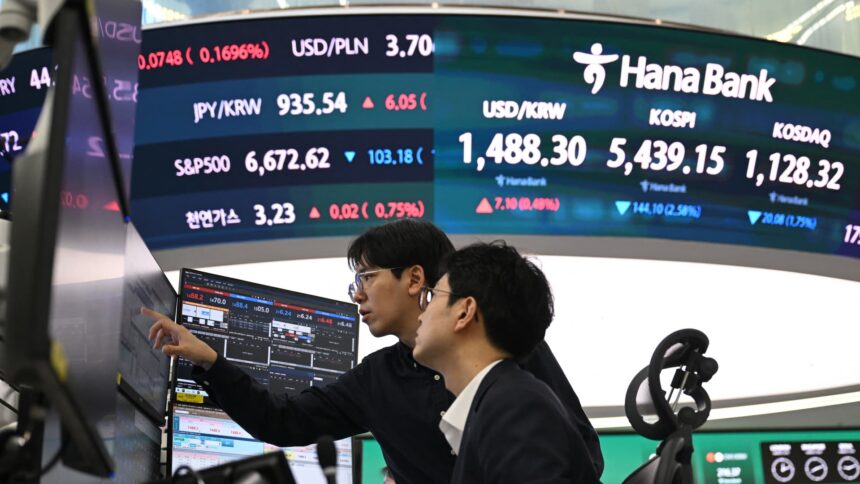
Currency dealers closely monitored exchange rates amidst significant turmoil in South Korea’s stock market, as indicated by an electronic screen showcasing the benchmark stock index (KOSPI) at the Hana Bank headquarters in Seoul. Recent developments saw the KOSPI experiencing heightened volatility, approaching record peaks, sparked by substantial foreign selling. Last week, foreign investors divested approximately $13.2 billion worth of local equities, leading to sharp fluctuations in the market and a temporary trading halt on the exchange.
In the early hours of trading, the KOSPI plummeted by as much as 4%, following an already steep 6% decline on Friday. Analysts at Goldman Sachs attributed this downturn to the significant pullback coinciding with the recent Trump-Xi Summit and ongoing strong foreign outflows. The KOSPI Volatility Index notably surged by 2.56% on Monday, nearing the highs witnessed earlier in March, reflecting the fraught market conditions.
Exacerbating the situation, overseas investors withdrew approximately $17 billion from emerging Asian markets, excluding China, marking one of the largest weekly outflows recorded. South Korea endured the heaviest selling, with the $13.2 billion outflow significantly outpacing Taiwan’s $2.5 billion.
In response to the drastic stock losses, South Korea’s exchange briefly suspended certain program trading on Monday. This decision was enacted following a dramatic plunge in stock-index futures, which triggered the “sidecar” mechanism designed to temper market volatility. The interruption occurred when the Kospi 200 futures fell by 5%, momentarily ceasing automated trading activities for a duration of five minutes.
This sharp reversal in fortunes follows a period of optimistic performance, during which the KOSPI had surged past the 8,000 mark for the first time, buoyed by euphoria surrounding artificial intelligence stocks, chipmakers, and retail investments. However, strategists at Citigroup flagged concerns over potential overvaluation in the Korean market compared to its U.S. counterpart. They suggested an adjustment of their stance by reducing exposure to bullish positions in Korea, emphasizing that while they anticipate an ongoing bull market, the KOSPI appears overbought and cautioned that risks have escalated.
Local retail investors, who have been significant participants in the market this year, often utilizing margin trading and leveraged exchange-traded funds, have contributed to the heightened buying activity. Citigroup’s observations suggest that although this doesn’t signal an end to the Kospi rally, it indicates an increase in market risks.
The growing fears of elevated global bond yields linked to geopolitical tensions, particularly regarding inflation and rising oil prices associated with the Iran conflict, are also adding to the market’s challenges. Nevertheless, both Goldman Sachs and Citigroup expressed optimism regarding South Korea’s equity market prospects, indicating that the recent pullback may not signify a prolonged downturn. Goldman noted record purchases from retail traders amounting to $14.1 billion last week, while Citigroup articulated its strategy to take profits on half of its Korea positions, maintaining expectations for substantial passive inflows related to the impending MSCI index rebalancing.