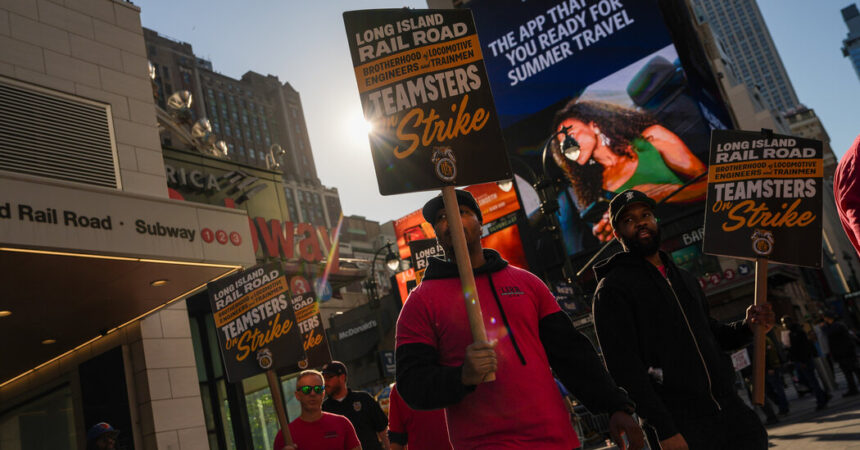
Negotiations between five unions representing Long Island Rail Road (L.I.R.R.) workers and the Metropolitan Transportation Authority (M.T.A.) have faced significant challenges primarily due to disagreements over wage increases, echoing a common theme in labor disputes across various sectors.
The unions, which represent nearly half of the railroad’s workforce, were prepared to accept a retroactive 9.5 percent wage increase for the past three years, matching agreements made with other transit and civil service unions in recent months. However, they also demanded an additional 5 percent wage raise for the current year, a request that surpassed the offers presented by the M.T.A. to other unions.
The five labor organizations involved in the negotiations are the Brotherhood of Locomotive Engineers and Trainmen, the Brotherhood of Railroad Signalmen, the International Association of Machinists and Aerospace Workers, the International Brotherhood of Electrical Workers, and the Transportation Communications Union. It is important to note that not all unions representing L.I.R.R. workers are currently on strike.
In response to the unions’ requests, the M.T.A. proposed a smaller raise for 2026 alongside a lump-sum cash payment. M.T.A. officials argued that adhering to their proposals would help maintain stability in negotiations with over 80 other unions currently in discussion. Among those is the Transport Workers Union, which represents transit employees across New York City.
Union leaders contend that their members are struggling to keep up with the high cost of living in one of the nation’s most expensive metropolitan areas, noting that workers have not received wage increases since 2022. A joint statement issued by two of the unions highlighted the unsustainable nature of waiting four years for a raise amid rising inflation and housing costs.
The situation is further complicated by a 1926 federal law that mandates mediation and an extended review period before a strike can be legally authorized. However, the National Mediation Board, the federal entity overseeing such disputes, released the unions from mediation last year, paving the way for a potential strike.
This impending strike, which has been postponed twice in the last year at the unions’ request for federal intervention, nearly came to fruition late on Friday as negotiations collapsed just hours before a strike deadline. A crucial point of contention was the wage increase for 2026, with parties remaining nearly 1 percentage point apart.
The unions also expressed concerns over a proposal from the M.T.A. that would require new employees to cover higher health care costs than current employees. Presently, current workers contribute up to 2 percent of their wages toward healthcare, but new hires could face costs nearing $3,500 annually for similar coverage.
Compensation for workers in the negotiating unions already averages over $136,000 annually, positioning them among the highest-paid rail workers in the country. However, M.T.A. officials suggested that they might consider the unions’ wage requests if they were willing to negotiate certain work rules that presently guarantee additional pay for specific tasks. The unions opted to maintain these existing agreements, which they argue protect worker rights and ensure fair compensation.
For example, an engineer switching from operating a diesel train to an electric one within the same shift is entitled to two days’ pay, while further changes in their responsibilities could add additional compensation. Such stipulations have reportedly contributed nearly 15 percent to the average engineer’s earnings in 2024.
The breakdown in negotiations highlights the ongoing struggle for fair wages and working conditions in the face of rising living costs, even as the M.T.A. grapples with its own financial challenges and commitments to various labor groups. With the potential for a strike looming, both parties face pressure to reach a resolution.