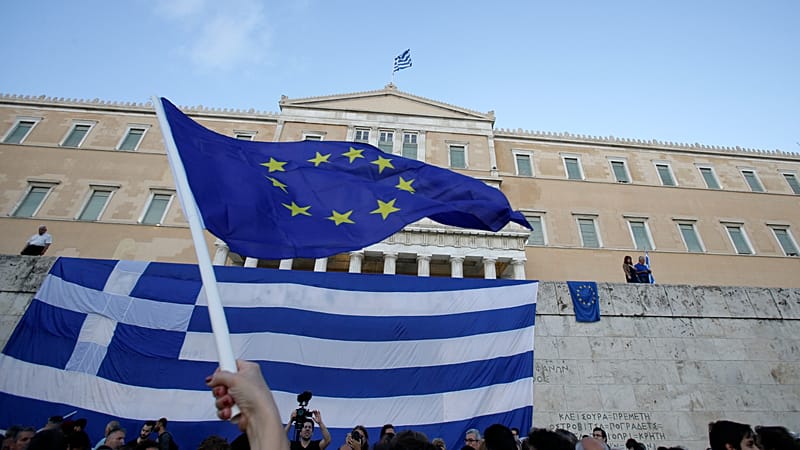
On the morning of June 29, 2015, the Greek financial landscape underwent a dramatic transformation as citizens awoke to the sight of closed banks and limited cash access from ATMs, restricted to €60 daily withdrawals. The Athens Stock Exchange was shuttered, marking the implementation of capital controls that were more familiar in crisis-stricken emerging markets than in a nation belonging to a developed-economy currency union. The groundwork for this turmoil was laid five years earlier when credit rating agencies, Standard & Poor’s and Moody’s, reduced Greek sovereign debt to junk status, making it the first eurozone member to lose its investment grade.
Fast forward to February 2016, and the Athens Composite Index had plummeted to unprecedented lows, sitting at 516.7 points—a staggering decline of over 90% from its peak of 5,334.5 in October 2007. The situation was equally dire for the country’s banks, the FTSE Athex Banks index, which had collapsed by a remarkable 99.6%. Greek equities had devolved into a shadow of their former selves, considered little more than an obituary of a lost era. Yet, a decade later, the narrative surrounding Greece has undergone a remarkable transformation.
As of recent analysis, the Athens Composite Index has soared by approximately 146% over the past five years, outpacing even the Nasdaq 100’s 116% gain during the same period. The S&P 500’s performance pales in comparison, contributing less than half of Greece’s remarkable resurgence. Thus, what was once viewed as a cautionary tale has emerged as one of the most compelling turnaround stories in contemporary financial history.
Central to this resurgence are the nation’s banks—National Bank of Greece, Eurobank, Piraeus Bank, and Alpha Bank—which bore the brunt of the crisis decade. By late 2016, their combined non-performing loan ratio had hit nearly 47%, the highest in the European Union. This stark reality highlighted that these institutions were not merely facing credit issues; they were weighed down by the remnants of a decade-long depression.
The recovery unfolded in two key stages. The first was the Hellenic Asset Protection Scheme, also known as Hercules, which allowed banks to securitize and offload about €57 billion in bad loans under state-backed guarantees. The second, more gradual, phase involved stabilizing deposits, restructuring cost frameworks, and restoring net interest margins. By 2025, the net profits of the top four Greek banks had surged to close to €5 billion, setting the stage for shareholder distributions. Piraeus, Eurobank, and Alpha Bank earmarked approximately 55% of their earnings for payouts, while the National Bank of Greece reached an impressive 86% payout ratio, bolstered by aggressive buyback strategies.
Konstantinos Hatzidakis, Greece’s economy and finance minister at the time, noted the significant progress made in an article for the IMF’s Finance & Development journal. He emphasized how cleaning up bank balance sheets and reducing non-performing loans allowed lenders to resume their crucial function in financing the economy. Hatzidakis highlighted the rising deposits, strengthened capital buffers, and an overall growing vote of confidence, as indicated by the successful sale of bank stakes to long-term foreign investors.
While bank recovery formed a significant pillar of Greece’s comeback, another equally vital aspect has been the transformation of the country’s tax administration. A recent IMF paper underscored this fiscal side as “one of the quiet engines behind Greece’s broader economic recovery.” The authors delineated three stages of reform that commenced in 2010, focusing first on stabilizing government revenues under Troika supervision. Initial breakthroughs, such as the digitalization of VAT, led to compliance rates rising dramatically—from 65% of registered taxpayers filing VAT returns on time in 2010 to 96% by 2014.
The consolidation of local tax offices, paired with the establishment of an Independent Authority for Public Revenue in 2016, led to an ambitious restructuring of the tax collection framework. By 2017, this authority was operational, and the tax-to-GDP ratio experienced a notable increase from 25.8% to 27.6%. The introduction of real-time electronic invoicing and digital analytics further boosted VAT revenues, leading to a significant fiscal turnaround. Greece recorded a primary surplus of around 5% of GDP for both 2024 and 2025, positioning it among the few EU countries operating with a fiscal surplus.
As a result of these concerted efforts, Greece’s public debt-to-GDP ratio decreased significantly, falling approximately 10 percentage points in 2025 and now resting around 145%, compared to a peak of nearly 210% in 2020. Credit rating agencies began to take notice, with several upgrading Greece to investment-grade status on multiple occasions throughout 2023 and 2025.
The recovery’s momentum was also fueled by attractive valuations. At the onset of this fiscal and banking reform, Greek equities traded at strikingly low discounts that defied justification as balance sheets began to stabilize. Currently, Greek banks are trading at approximately nine times expected 2026 earnings, lagging behind their European counterparts and signaling potential for further growth. Even after this dramatic surge, leading banks have retained single-digit earnings multiples.
Furthermore, structural changes are now evident, including the acquisition of the Athens Stock Exchange by Euronext, broadening the investor base and enabling Greek companies to access larger capital pools. This shift has drawn the attention of MSCI, which is reviewing Greece for a potential upgrade to Developed Market status.
Despite these advances, Greece continues to face challenges, including vulnerability to external shocks and ongoing inflationary pressures. The warning from the IMF regarding geopolitical tensions in the Middle East serves as a reminder of the delicate balance the country must maintain. Grecian leaders continue to acknowledge lingering issues, from investment levels to labor market participation rates.
Nevertheless, Greece has undergone a dramatic transformation over the past decade, evolving from a symbol of financial collapse to a noteworthy case study in recovery. Ten years after being cast into financial turmoil, the nation’s sovereign debt is once again investment grade, and its stock market performance presents a remarkable contrast to its bleak past. The outlook may remain uncertain, but Greece stands as a testament to resilience and strategic reform in modern financial history.