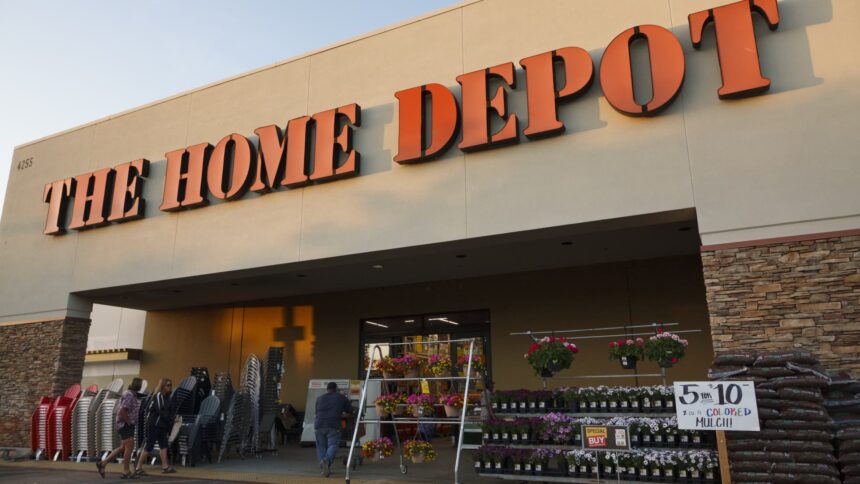
Home Depot has demonstrated resilience among its core homeowner shoppers in the face of economic challenges such as rising gas prices and diminished consumer confidence. The retailer reaffirmed its full-year guidance after surpassing fiscal first-quarter expectations.
In a recent interview, Home Depot’s finance chief, Richard McPhail, stated that financially, the homeowner demographic appears to be less affected than other customer groups. He noted continued engagement among this segment, despite acknowledging the impact of geopolitical tensions and a deteriorating housing market. However, McPhail highlighted that homeowners have indicated a tendency to defer spending on larger projects, a trend he associated with feedback from previous years.
Following the earnings release, Home Depot’s shares saw a modest increase in premarket trading. The company’s performance compared favorably against Wall Street expectations, as shown in a survey conducted by LSEG. For the first fiscal quarter, Home Depot reported an adjusted earnings per share of $3.43, which slightly exceeded the anticipated $3.41. Revenue also came in stronger than expected at $41.77 billion, surpassing the forecast of $41.52 billion.
The reported net income for the three months ending May 3 was $3.29 billion, or $3.30 per share, although it marked a decline from the previous year’s figures. Excluding special one-time costs associated with intangible assets, Home Depot’s adjusted earnings per share aligned with the company’s outperformance against earlier projections.
Looking ahead, Home Depot is forecasting fiscal 2026 sales growth between 2.5% and 4.5%, slightly lower than the market’s expectation of roughly 4%. However, the retailer anticipates adjusted earnings per share growth could reach up to 4%, surpassing the analysts’ forecast of 2.4% growth.
Despite beating earnings expectations, Home Depot’s reports suggest ongoing pressure from external economic conditions. Comparable sales for the quarter rose just 0.6%, falling short of the 0.8% expected by analysts and marking a third consecutive quarter of minimal fluctuation in that key metric. Additionally, comparable transactions decreased by 1.3%, reflecting a fourth straight quarter of decline. Gross margins also fell short, at 33%, compared to anticipated expectations of 33.2%.
The home improvement sector, including Home Depot, has faced significant headwinds due to lower housing turnover and economic uncertainties, which have caused delays in costly projects. Early optimism regarding a potential rebound driven by lower mortgage rates has waned, particularly after the recent conflict in the Middle East led to another spike in these rates.
To diversify its revenue streams, Home Depot is increasingly targeting professional customers, such as contractors and roofers, who currently contribute approximately 50% of its revenue. The company recently acquired SRS Distribution for $18.25 billion, positioning itself to serve roofing, landscaping, and pool professionals. This acquisition builds on last year’s purchase of GMS, a distributor of specialty building products.
In a related move, SRS also acquired Mingledorff’s, a wholesale distributor of HVAC equipment, which bolsters Home Depot’s capabilities in a sector with a total addressable market estimated at around $100 billion. McPhail emphasized the retailer’s strategy to expand its pro capabilities and capture greater market share in the projected $700 billion market for professional services. Although he expressed confidence in Home Depot’s potential, he acknowledged that the company has yet to fully capitalize on these opportunities.