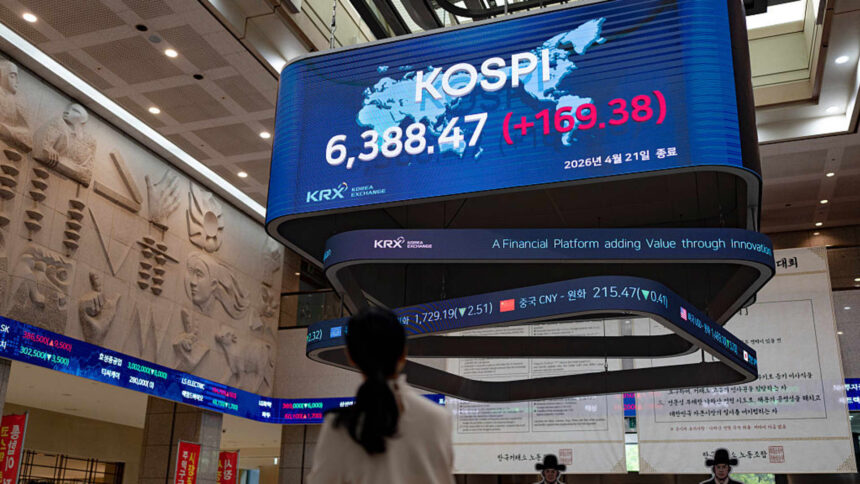
An employee was seen smiling while checking her mobile phone in front of a digital board displaying the Korea Composite Stock Price Index (KOSPI) at the Korea Exchange in Seoul, highlighting the positive sentiment in North Asian markets. A senior strategist at Goldman Sachs, Tim Moe, noted that these northern markets are outperforming their southern counterparts due to several key factors, including better insulation from energy price shocks, stronger fiscal capabilities, and advancements in artificial intelligence.
Moe pointed out that North Asian markets possess “greater buffer stocks,” allowing them to afford higher prices for oil and gas. In contrast, South Asian markets are struggling due to “much fewer buffers” and insufficient fiscal resources to absorb rising energy costs. He characterized the disparity in performance as “massive,” particularly emphasizing that markets in Indonesia and other South Asian countries are vulnerable due to minimal technological investment and significant energy dependency, leading to a decline of approximately 25%.
Investors are increasingly focusing on AI developments in regions like Taiwan, South Korea, and Japan, where technology-oriented companies contribute significantly to market indices — about 80% in Taiwan, 60% in South Korea, and 30% in Japan. South Korea and Taiwan are currently the best-performing markets, with South Korea’s KOSPI up by over 80% year-to-date.
However, Moe cautioned about the valuation of key Korean semiconductor players, noting that stocks such as Samsung Electronics and SK Hynix are trading at low earnings multiples, suggesting market skepticism about sustaining their profitability. Furthermore, he expressed optimism regarding Japan, citing political stability and promising earnings growth in the context of AI and robotics.
Turning to China, Moe observed that A-shares, which are traded in yuan on the mainland, have outperformed H-shares traded in Hong Kong, rising by 10% year-to-date. This performance is attributed to solid policy support for the structural development of the Chinese equity market and the recent positive shift in the Producer Price Index after over three years of deflation. However, H-shares face challenges due to weak earnings from major stocks, particularly in the internet sector, which has suffered as investor interest has shifted toward hardware related to AI.
Reflecting on the recent meeting between Chinese President Xi Jinping and U.S. President Donald Trump, Moe suggested that no negative outcomes resulted from the discussions, indicating a desire for calm amid ongoing geopolitical tensions.
Despite these positive sentiments, he warned of a potential “rude awakening” when the energy supply shock fully materializes, predicting possible corrections in the market during the summer months. This impending concern remains a focal point for investors, emphasizing the need for vigilance in the current market landscape.