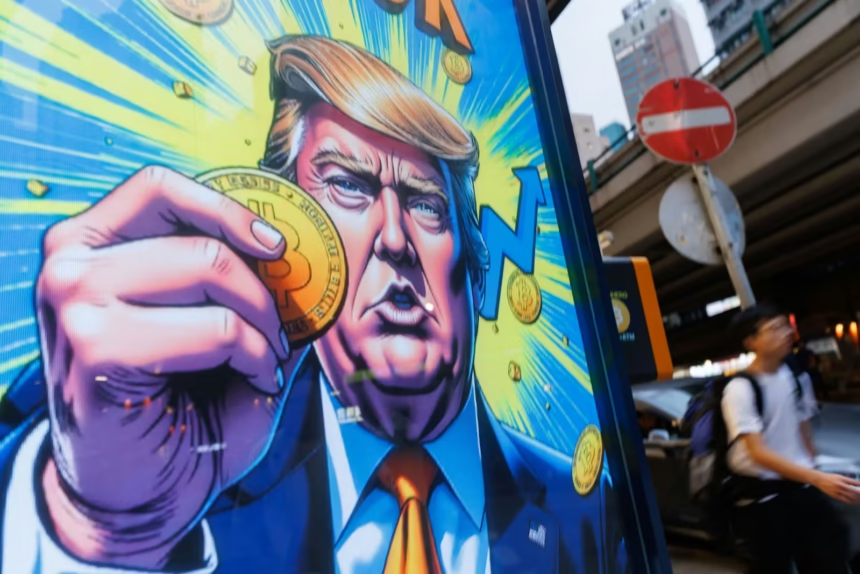
Bitcoin exchange-traded funds (ETFs) have experienced significant outflows this week, with nearly $1 billion exiting the market in just two days. This trend is poised to surpass the $1 billion in outflows seen in the previous week, according to data from SoSoValue. In a sign of the increasingly competitive ETF landscape, Trump Media & Technology Group has withdrawn its application for a bitcoin ETF, which had originally been filed in June 2025.
Bitcoin ETFs have played a crucial role in supporting bitcoin, particularly amid geopolitical tensions and macroeconomic challenges. However, analysts warn that a consistent decline in inflows could erode this support and contribute to a decrease in bitcoin prices. This comes after bitcoin dipped below the significant $80,000 mark, now fluctuating between $76,100 and $77,550 over the last 24 hours. Factors contributing to this price dynamics include rising bond yields and ongoing uncertainty surrounding the war in Iran.
Dean Chen, an analyst at Bitunix, commented on the current state of the market, stating, “Bitcoin has recently remained trapped between $76,000 and $78,000, reflecting a market still waiting for macro direction. If global long-end yields continue moving higher, we could see volatility across risk assets heighten sharply once again.”
Tim Sun, a senior researcher at HashKey, indicated that the past two weeks of outflows, occurring right after six consecutive weeks of inflows, signal that the rebound in early May was not sustainable. “This indicates that institutional capital was actually reducing positions rather than adding to them as prices spiked,” he explained.
Analysts at Bitfinex have echoed concerns regarding bitcoin’s price performance, suggesting that its fall below $78,000 reveals underlying structural weaknesses within the crypto market. The decline in two major sources of demand—spot ETFs and leveraged yield vehicles—occurs concurrently with deteriorating macroeconomic conditions. This shift has made bitcoin increasingly susceptible to external shocks.
On-chain capital flows are no longer exhibiting the robust institutional confidence necessary to support previous market uptrends. According to Glassnode analysts, with weakened ETF inflows and tepid institutional demand, the dynamics of the market become significantly strained. They indicated that traditional finance sentiment is also deteriorating, as evidenced by a 6.1% decline in the U.S. Spot ETF market value to realized value (MVRV) ratio.
Despite the recent outflows, Ishmael Asad, a Bitwise research analyst, pointed out that year-to-date net flows for bitcoin ETFs still remain moderately positive, at approximately +$432 million, despite a negative year-to-date return for bitcoin itself of -12.3%.
Accompanying the outflow turmoil, Trump Media & Technology Group not only withdrew its Bitcoin ETF application but also announced the retraction of filings related to its Bitcoin and Ethereum ETFs as well as its Crypto Blue Chip ETF. Yorkville America Digital, the sponsor of the Truth Social Bitcoin ETF, described the withdrawal as a “proactive strategic decision,” suggesting that a 40 Act structure would be more advantageous.
Bloomberg Intelligence analyst James Seyffart observed that a key factor in the withdrawal could be the cutthroat nature of the bitcoin ETF market. He noted, “A 33 act ETP is different from a 40 act ETF and it has less protections. Anyone in this space knows that. Nothing has changed.”
In a competitive landscape, Morgan Stanley recently launched its Morgan Stanley Bitcoin Trust fund on the New York Stock Exchange, which now holds $232.69 million in assets under management. This figure, while modest compared to the $61.99 billion assets managed by BlackRock’s iShares Bitcoin ETF, reflects the stark contrasts in fee structures within the ETF category. Morgan Stanley’s fund charges a mere 0.14% fee, making it the lowest among bitcoin ETFs, in stark contrast to BlackRock’s 0.25% and Grayscale’s 0.15% fees.