A Ukrainian national has made her first court appearance in Oregon following her extradition from Thailand, where she was arrested in connection with a $340 million global cryptocurrency fraud case. Olena Oblamska, also known by the moniker Lola Ferrari, is alleged to be one of the four founders of the Forsage cryptocurrency investment platform, which prosecutors argue was actually a Ponzi and pyramid scheme rather than a legitimate investment opportunity.
Oblamska, 42, faces charges of conspiracy to commit wire fraud. Her arrest in Thailand occurred in February at a condominium in Phuket, although details were not disclosed at that time. After being extradited to the United States in May, she appeared in federal court on May 12, where she pleaded not guilty and was remanded in custody pending a jury trial scheduled for July.
According to prosecutors, Oblamska played a pivotal role as the self-proclaimed “goddess” of Forsage, which she promoted on various internet platforms, falsely depicting it as a low-risk and potentially lucrative investment opportunity. The alleged scheme reportedly siphoned approximately $340 million from victim-investors, with the majority losing money. Investigators have found that over 80% of participants received less cryptocurrency than what they originally invested, while more than half received no payout at all.
The indictment also implicates Vladimir Okhotnikov, a Dubai-based Russian national who reportedly directed Forsage’s operations. Okhotnikov is evading criminal charges in both the United States and Georgia and fled to the United Arab Emirates. His involvement in the scheme was scrutinized by the International Consortium of Investigative Journalists (ICIJ) as part of a broader investigation into the cryptocurrency sector’s connection to illicit financial flows.
Forsage, which launched in 2019, leveraged social media and online marketing to attract investors. According to court documents, the platform required participants to purchase positions using cryptocurrency, funneling new investors’ funds to earlier participants—a hallmark of Ponzi schemes.
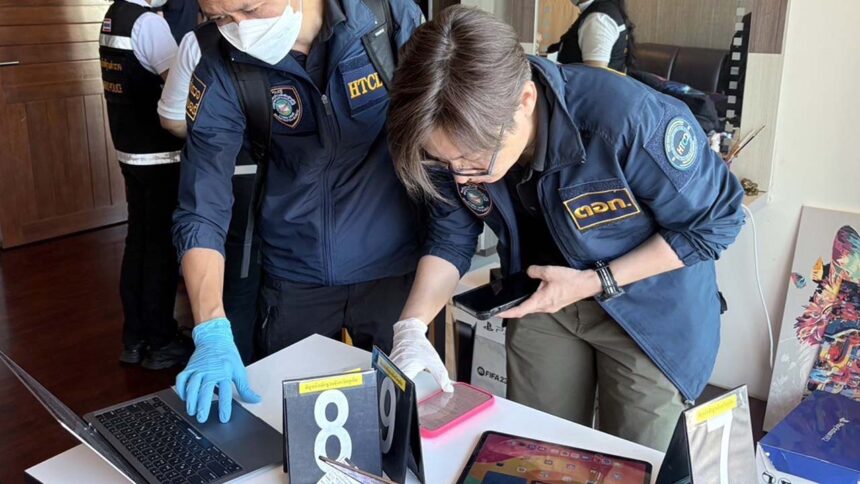
Aside from Oblamska, co-defendants Mikhail Sergeev and Sergey Maslakov also face similar charges. If convicted, Oblamska could be sentenced to a maximum of 20 years in federal prison and fined up to $250,000. The criminal investigation was aided by the U.S. Department of Justice, FBI, and Thailand’s Cyber Crime Investigation Bureau, which seized a range of digital devices and documentation during Oblamska’s arrest.
Notably, Oblamska had been initially reported missing and believed to be on the run in Bali, Indonesia, and was previously identified as Russian. Despite claims by Oblamska and Okhotnikov that 50 individuals became millionaires through Forsage, authorities dispute this, asserting that blockchain analysis indicated only one user ID tied to the founders benefitted significantly, receiving over a million dollars in cryptocurrency.
As the legal proceedings unfold, the U.S. Department of Justice has urged any victims of the Forsage scheme to come forward. The case underscores ongoing concerns regarding the regulation of cryptocurrency ventures and the protection of investors in an increasingly complex financial landscape.