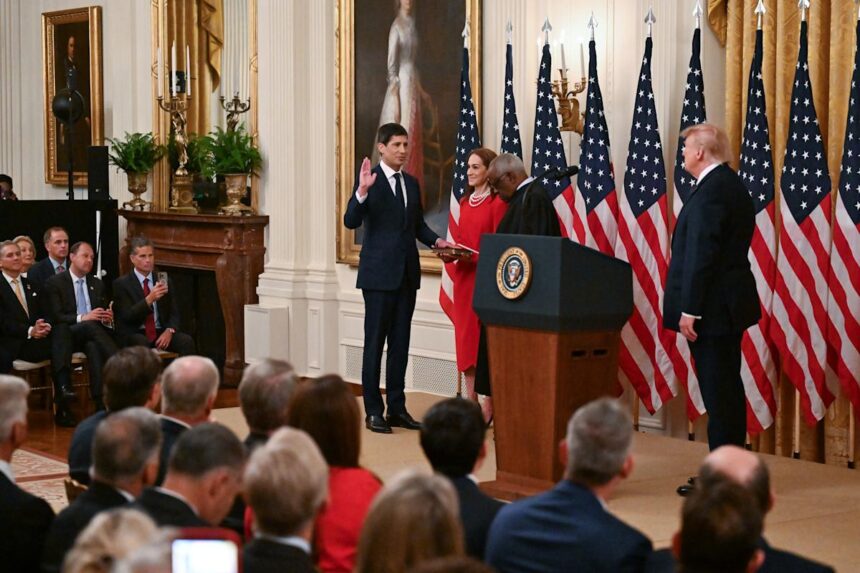
Kevin Warsh has officially assumed the role of chairman of the Federal Reserve, marking a significant moment in U.S. economic governance. The transition was celebrated with a swearing-in ceremony on Friday, conducted by Supreme Court Justice Clarence Thomas in the East Room of the White House. This event is notable as it is the first time since Alan Greenspan’s appointment in 1987 that a Federal Reserve Chair has taken the oath of office at the White House.
During the ceremony, Warsh acknowledged Greenspan’s influence, remarking, “He was the first to tell me and show me what this role demands.” In his inaugural address, Warsh expressed his commitment to leading a “reform-oriented Fed,” indicating a potential shift in policies and priorities that may impact the nation’s economic landscape.
Warsh’s confirmation by the U.S. Senate came on May 13, where he was approved by a narrow 54-45 vote. Notably, he received bipartisan support from one Democrat, John Fetterman of Pennsylvania, which signified some political alignment in a typically polarized environment. His appointment comes amid pressure from the White House for lower interest rates, a stance heightened by changing economic conditions.
Since Warsh’s nomination in January, the global economic climate has evolved, particularly with the crisis in Iran causing oil prices to soar and inflation to climb. The state of the job market appears to be stabilizing, complicating the argument for rate cuts that President Trump is advocating for. Trump explicitly addressed this tension, urging Warsh to be “totally independent” in his decision-making, emphasizing a clear separation between the Fed’s operations and political influences.
Warsh’s tenure begins at a challenging time, with inflation persisting above the Federal Reserve’s target of 2% for over five years. Recent data reveals that wholesale prices surged by 6% in April, primarily due to rising energy costs. Analysts highlight that this inflationary pressure complicates Warsh’s ability to advocate for further cuts to interest rates.
Economic experts have noted that the Fed’s current relationship with inflation is precarious. Krishna Guha, head of economics and central banking strategy at Evercore ISI, pointed out that the latest inflation data presents a significant hurdle for Warsh. The Federal Reserve typically uses the Personal Consumption Expenditures index to gauge inflation; however, Warsh has suggested that this method is insufficient, advocating instead for “trimmed averages” that offer a more refined perspective on underlying inflation trends.
Despite his relatively optimistic view on inflation, Warsh may face challenges convincing fellow Fed officials, who are increasingly wary of persistent inflation, particularly in services like haircuts and lawn maintenance that are not easily swayed by oil prices or tariffs. The situation is compounded by the Fed’s recent data indicating an increase in the Consumer Price Index, rising to 3.8% in April.
Warsh’s approach may soon lead to intra-Fed tensions, particularly if he advocates for cuts that do not align with a majority of the committee. Analysts warn that failure to address President Trump’s expectations may lead to further scrutiny regarding the Fed’s independence. The evolving landscape of inflation and economic health suggests that Warsh’s leadership will likely be marked by debate and contention as he navigates the complexities of monetary policy in an unpredictable environment.