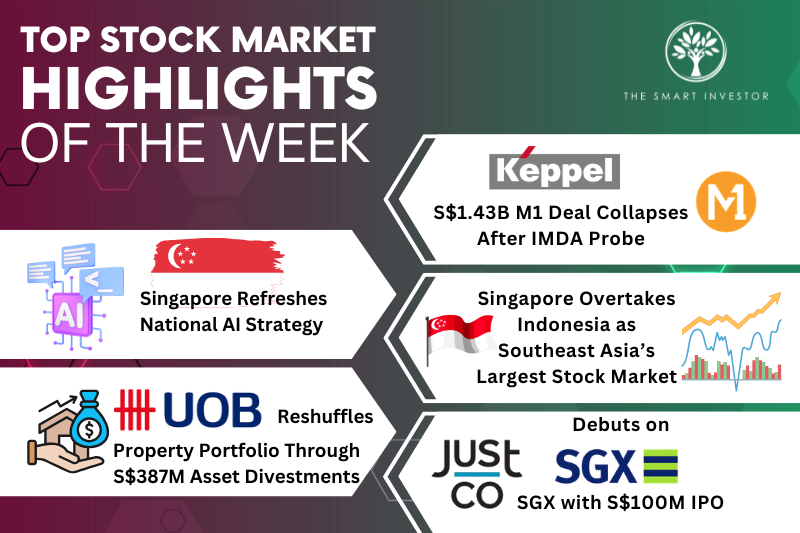
This week has marked a transformative period for Singapore’s financial landscape, with the country officially surpassing Indonesia to become Southeast Asia’s largest stock market. The Straits Times Index (STI) hit record highs, reinforcing Singapore’s robust economic position amid a backdrop of notable developments across various sectors.
One of the most significant events was the abrupt cancellation of Keppel Ltd’s S$1.43 billion deal to sell its telecom subsidiary M1 to Australia’s Simba Telecom. The expiration of the long-stop date on May 21 led to revelations that the Infocomm Media Development Authority (IMDA) had halted its regulatory assessment to investigate unauthorized use of radio frequency bands by Simba. This serious violation of the Telecommunications Act has considerable legal ramifications, including the potential for sanctions amounting to S$1 million or 10% of custom sales.
In light of this collapse, Keppel has revised its financial strategies, removing the anticipated S$1 billion cash proceeds from its future asset monetisation targets while still aiming for a broader goal of S$2 billion to S$3 billion in 2026. To mitigate disruptions, the company has swiftly activated a “Plan B” to retain operational control over M1, launching an immediate 90-day efficiency plan focused on technology cost reduction and the incorporation of artificial intelligence for operational automation.
Meanwhile, Singapore’s government has unveiled an updated National AI Strategy, signaling its commitment to becoming a hub for artificial intelligence innovation. Minister for Digital Development and Information, Josephine Teo, announced partnerships with global tech leaders OpenAI and Google, aimed at enhancing healthcare, education, and enterprise innovation. OpenAI’s commitment of over S$300 million and the establishment of its first Applied AI Lab outside the U.S. underscores Singapore’s appeal in the tech realm. The strategy outlines ten new priorities, including goals to assist 10,000 enterprises in adopting AI technologies within three years.
In a remarkable shift, Singapore overtook Indonesia as the largest stock market in the region, largely due to differing investor sentiments and macroeconomic conditions. Singapore’s market capitalization has reached US$645 billion, while Indonesia’s has seen a significant decline. The disparity reflects ongoing investment confidence in Singapore, driven by political stability and favorable economic reforms, in contrast to Indonesia’s recent credit downgrades and outflows of investor capital.
In another development indicating strategic shifts in the property market, United Overseas Bank (UOB) announced plans to divest S$387 million worth of property interests to related parties. These transactions, involving stakes in Novena Square and 230 Orchard Road, are part of UOB’s capital reallocation strategy and are expected to enhance recurring income for its partners.
Additionally, JustCo, a co-working space operator backed by GIC, marked its debut on the SGX Mainboard by raising S$100 million through a highly successful IPO, which was oversubscribed by 3.4 times. The company’s strong demand reflects growing interest in flexible workspace solutions as it expands its presence across the Asia-Pacific region.
As Singapore continues to navigate these pivotal changes, it solidifies its reputation as a leading regional market, attracting global investments and fostering innovation across various sectors.