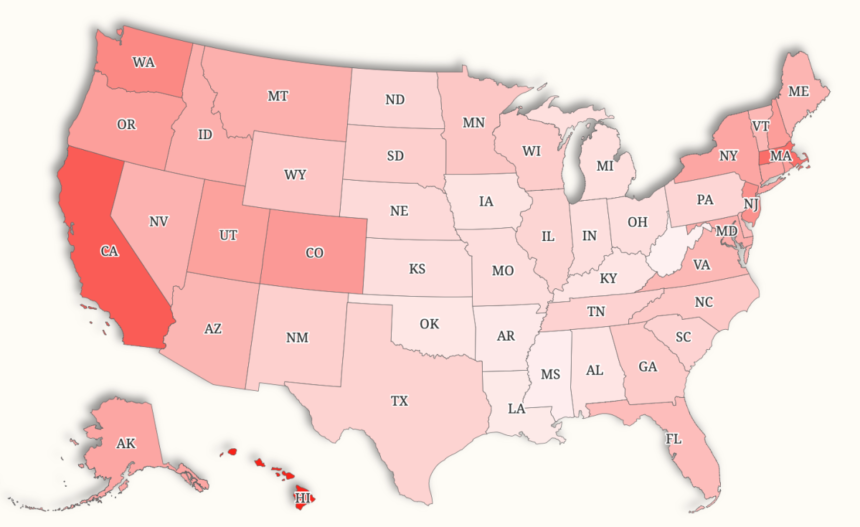
A comprehensive analysis has revealed significant disparities in retirement costs across the United States, highlighting how geographical location affects financial needs for a comfortable post-work life. Current data shows that annual expenses for retirees can exceed $100,000 in certain states, illustrating a pressing concern for many seniors.
The Federal Reserve Bank of St. Louis reports that individuals aged 65 and older spent an average of $61,432 in 2024, marking a 2.2 percent increase from the previous year. This figure, however, represents less than half of the projected costs for retirees in the nation’s most expensive states, as detailed by recent findings from Money Lion.
Seniors nationwide are grappling with rising living expenses, and in many states, the financial toll to sustain a comfortable lifestyle in retirement has surged above six figures annually. Leading the pack is Hawaii, where retirees need approximately $156,610 each year. California follows, with an estimated annual cost of $121,879, and Massachusetts rounds out the top three at $111,145. Other states notably affected include Washington and New Jersey, necessitating annual expenditures of $95,099 and $90,511, respectively.
Overall, thirteen states demand over $100,000 annually for retirees to maintain a comfortable living standard, predominantly located in the West and Northeast regions of the country. These states not only report high retirement costs, but they also typically boast some of the highest median household incomes. Massachusetts registers the highest median income at $104,828, closely trailed by New Jersey and Maryland, while California and Washington hover around the $100,000 threshold.
Conversely, retirement costs are significantly lower in certain Southern and Midwestern states. West Virginia emerges as the most affordable option, with annual living expenses for a comfortable retirement estimated at just $33,223. Mississippi follows closely, requiring about $35,130 annually, while Louisiana, Arkansas, and Oklahoma present costs of roughly $37,570, $37,811, and $39,286, respectively. These states also exhibit lower median household incomes, which remain above the annual retirement costs.
The typical spending breakdown for retirees outlines that a substantial portion of their budget is allocated to housing, averaging $22,193 a year. This figure constitutes roughly one-third of overall spending and includes rent or mortgage payments, taxes, maintenance, utilities, and other related expenses. Transportation emerges as the second-largest expenditure, averaging $9,538 annually due to vehicle costs, fuel, and insurance. Food expenses come next, averaging $7,940 annually, while healthcare costs, which include insurance premiums and medical expenses, average about $7,799.
Despite the affordability of certain regions, many American retirees express apprehension regarding their financial security in later years. A recent survey by Schroders highlights that 49 percent of retirees believe that their expenses have surpassed their expectations, and 58 percent are uncertain about the longevity of their savings. Inflation is identified as the primary concern, with 90 percent of retirees expressing at least some anxiety related to its impact on their financial assets. Healthcare costs are another significant worry, with 87 percent fearing unexpectedly high medical expenses.
Other notable concerns include potential market downturns affecting retirement savings (81 percent), uncertainties regarding efficient savings withdrawal strategies (69 percent), and the risk of outliving their financial resources (68 percent). As these trends unfold, the importance of thorough retirement planning becomes increasingly evident for current and future retirees.