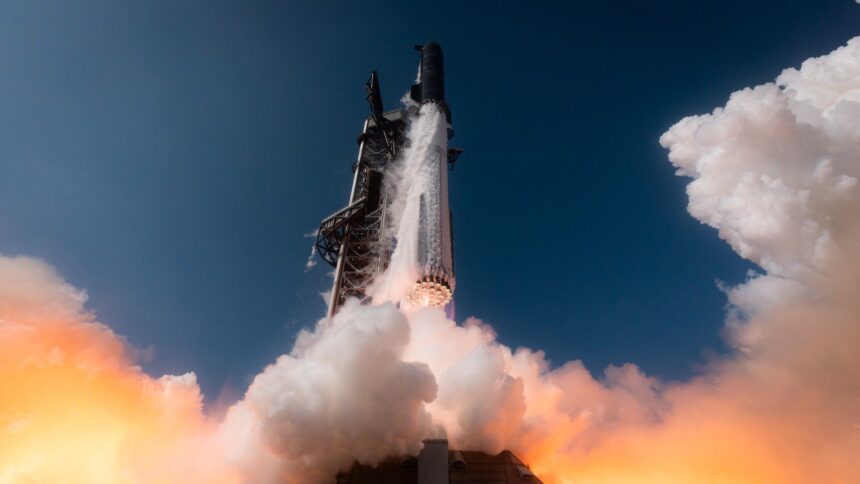
SpaceX’s latest test flight of its Starship V3 rocket was a significant milestone, showcasing the advancements made in its design and capabilities. The launch took place from the SpaceX Starbase test site in South Texas on May 22 at 6:30 p.m. EDT. This impressive launch saw the rocket travel into suborbital space before both the Starship Super Heavy booster and its upper stage executed fiery splashdowns, marking the mission’s conclusion.
The Starship V3 is not just another test flight for SpaceX; it represents the 12th overall mission for the Starship program and features a completely new design. Standing tall at 408 feet (124 meters), it is larger and more powerful than any of its predecessors, demonstrating SpaceX’s commitment to pushing the boundaries of space travel.
Among the key upgrades in this version are several enhancements aimed at improving performance and safety. A new fuel transfer tube allows for more efficient fuel handling, while a faster PEZ deployment system is set to benefit future satellite launches. The rocket is powered by 39 Raptor engines across its two stages, showcasing a more robust propulsion system. Additionally, it utilizes three grid fins for reentry guidance, down from four, and introduces a reusable “hot stage ring” that plays a crucial role at the intersection of the Super Heavy booster and the Ship upper stage.
This successful test flight is critical for SpaceX as it aims to secure future opportunities within NASA’s Artemis program. The competition is particularly stiff, with Blue Origin also vying for contracts related to lunar exploration. Currently, SpaceX is slated to land astronauts on the Moon during the Artemis 4 mission, which is set to launch as early as late 2028. However, prior to that milestone, Starship must demonstrate its capabilities, including flight in Earth orbit, fuel transfer operations, and the housing of astronaut life-support systems.
In recent developments, NASA has restructured its Artemis 3 mission to involve an Earth-orbiting test, where the Orion spacecraft will rendezvous with a Human Landing System provided by either Blue Origin’s Blue Moon or SpaceX’s Starship. This shift opens the door for potential collaboration or competition, depending on which company is more prepared by the mission’s timeframe.
While Blue Origin plans to launch its Blue Moon prototype later this year, it has yet to send it into space, whereas SpaceX continues to push forward with its testing schedule. As the space race intensifies, both companies are striving to prove their readiness for the next phase of lunar exploration.