Bitcoin, with its digital essence, offers numerous advantages, particularly in self-custody, which makes theft and confiscation challenging. Its ability to transfer value globally at exceptional speeds has transformed financial transactions, enabling settlements in mere minutes. However, despite its technological benefits, Bitcoin often perplexes users due to its intangible nature—being purely digital, it cannot be held or touched, posing a barrier for many who seek a more tactile experience. To address this, entrepreneurs and artists have endeavored over the past decade to create physical representations of Bitcoin, but the complexity of maintaining its essential properties complicates matters.
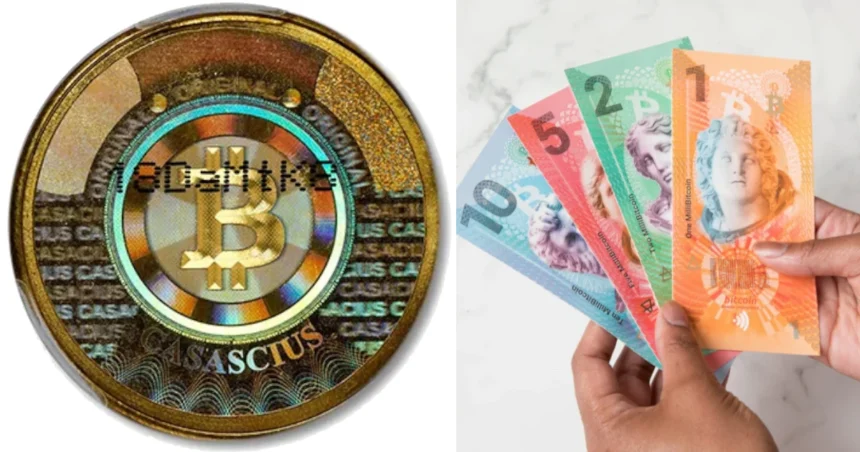
One of the earliest attempts to embody Bitcoin physically was through Casascius coins, minted starting September 2011 when Bitcoin was priced around $8. These coins are celebrated in the cryptocurrency community and inspired several imitators. The term “Casascius” stems from Mike Caldwell’s online pseudonym, reflecting the straightforward nature of his endeavor. Caldwell established meticulous practices that influenced subsequent physical Bitcoin projects, particularly concerning private key management—a critical factor since Bitcoin operates through cryptographic keys.
Caldwell generated the private keys in a secure, airgapped environment, then printed and affixed them to the coins. The keys were shielded with specialized tamper-proof stickers, revealing any unauthorized access with a distinctive honeycomb pattern. Buyers thus had some assurance that the private keys had not been compromised when purchasing from third-party vendors. Despite these precautions, the model relied on a degree of trust in Caldwell’s processes. His transparency contributed to his strong reputation, which ultimately benefitted many collectors when the coins gained significant value. Notably, Casascius coins were discontinued in November 2013 following regulatory scrutiny by the Financial Crimes Enforcement Network (FinCEN).
The rise of RavenBit coins a year later aimed to decentralize the minting challenge through a different approach, where users could generate their key pairs and affix them to their coins. Although this theoretically decentralized the minting process, it introduced risks related to trust. Unlike prior models, there were no established brands or reputations, leading to uncertainties about the security of personal key generation. The RavenBit project has since been abandoned, serving as a cautionary tale for future physical Bitcoin initiatives.
To navigate the traditional minting issue, Coinkite introduced Opendime, a small device designed to facilitate the transfer of Bitcoin as a bearer asset. Opendimes allow users to generate private-public key pairs on the device itself, securing the private key behind tamper-proof technology. Users provide entropy during the setup process to enhance security, and while the public key is accessible via any computer, accessing the stored bitcoins requires the physical destruction of the device, ensuring the private key’s security.
Opendime has carved out a niche in the Bitcoin ecosystem, blending hardware with attractive pricing. However, despite its innovations, the cost and physical form factor still distance it from everyday transactional utility, raising concerns about its practicality in routine purchases.
Satochip has sought to make further strides with its credit card-like Bitcoin wallets, maintaining similar capabilities to Opendime. Priced more affordably, these devices aim to offer a more familiar format for users engaging in everyday transactions while still ensuring high-security measures.
Yet, the pursuit of cash-like physical Bitcoin encounters fundamental challenges. For Bitcoin hardware to become viable for low-denomination transactions, manufacturing costs must plummet. Current production costs for U.S. currency indicate that hardware capable of Bitcoin transactions needs to be significantly cheaper than existing offerings.
Efforts to develop NFC-enabled Bitcoin chips have shown potential, but practical implementation remains elusive, often replicating previously encountered challenges surrounding trust and authenticity verification. The reliance on online validation complicates the cash-like concept, hindering the evolution of a purely physical Bitcoin currency.
Despite the complexities and obstacles, Coinkite has proposed the Tapsigner—a device that combines the functionality of a debit card with the security of the Bitcoin wallet. It allows for the seamless transfer of bitcoin, integrating easily with existing payment infrastructures, offering hope for broader adoption of Bitcoin in everyday commerce. As the industry continues to evolve, the quest for practical and trustworthy physical representations of Bitcoin persists, embodying the ongoing dialogue surrounding cryptocurrency’s future and its integration into daily financial practices.