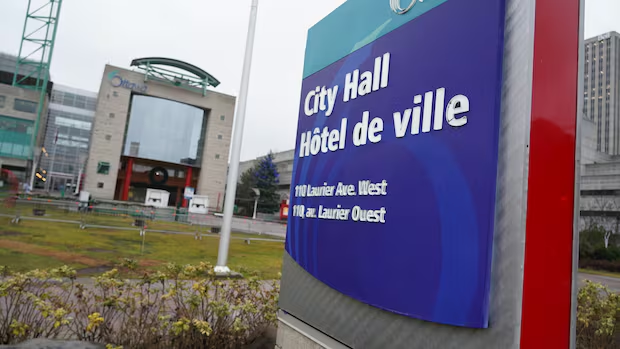
Investors in recent years have capitalized on a booming market, achieving significant financial gains. However, the City of Ottawa is facing scrutiny for what many see as a missed opportunity to capitalize on similar trends, as it reportedly lost tens of millions of dollars due to delays in restructuring its investment system.
Traditionally, Ottawa managed its long-term reserve funds through conservative investments yielding minimal returns, typically less than two percent annually. In 2019, the provincial government amended regulations, allowing municipalities to diversify their investments into a broader range of assets, including global stock market funds. Following this policy change, the city council authorized a new investment strategy in June 2022 under the leadership of former mayor Jim Watson. City staff were tasked with crafting new investment policies and establishing a board to oversee these investments, aiming to increase returns significantly.
However, the transition was protracted, taking over three years to implement. By December 2025, the city finally allocated more than $800 million from its reserve funds to the new assets. During this extended delay, comparable investments in the market surged by over 25 percent.
City Chief Financial Officer Cyril Rogers defended the lengthy process, noting that assessing the situation in hindsight may inaccurately suggest a loss. He stated, “It’s kind of a hypothetical thing. If the markets weren’t doing good and we did invest in 2022, you would be asking me the inverse question.” He emphasized that establishing the necessary governance framework and board was crucial, despite the lengthy timeline.
Ottawa’s reserve funds, which exceed $1 billion annually, are critical for various city functions, including funding capital projects and providing fiscal security during unforeseen events. Historical returns on these investments were dismal; in 2021, the yield was a mere 1.5 percent, and returns remained under two percent in subsequent years.
The city anticipated a change with the approval of the new investment strategy in 2022, including the formation of an investment board and an external fund management company. However, the necessary draft policies were delayed until 2024, with final approval not granted until September 2024. Rogers described the process as challenging, noting the added complexity from council turnover and the pandemic, which hindered the timeline further.
As a result, Ottawa’s long-term investments continued their lackluster performance, yielding returns of 1.7 percent in 2022 and fluctuating slightly in the following years. In contrast, short-term investments performed better, yielding over five percent as interest rates climbed.
Significantly, in April 2025, the city selected fund manager Mercer to oversee its new investment strategy. Following this, the city sold off a portion of its long-term fixed-income funds, realizing a gain of $19.5 million. It subsequently allocated over $800 million to Mercer, dividing the investments between fixed-income assets and equity funds.
The investment board recently convened for an update, revealing that the funds had remained stable during the initial four months of operation, coinciding with a market downturn influenced by geopolitical tensions. With only four months of data, Rogers cautioned against drawing conclusions about long-term performance fluctuations following market trends.
Despite the recent market highs since the establishment of the new investment policy, Rogers emphasized a cautious approach. He noted that while U.S. stocks surged by 75 percent and Canadian stocks by 55 percent from 2022 to the end of 2025, the city couldn’t expect to achieve those returns with a conservative public funds strategy. The municipality aims for a balanced portfolio with an expected rate of return around five percent.
Comparatively, several other municipalities that adopted new investment regulations earlier have realized more substantial returns. Municipalities like Aurora and Thunder Bay reported returns exceeding ten percent within a year of their transitions.
Although Ottawa’s investment board has commenced operations, concerns linger as residents compare its performance to other cities like Toronto, which saw better annual returns due to its advanced legislative framework. Rogers remains optimistic about the future, stating that the focus should be on long-term growth rather than past performances.