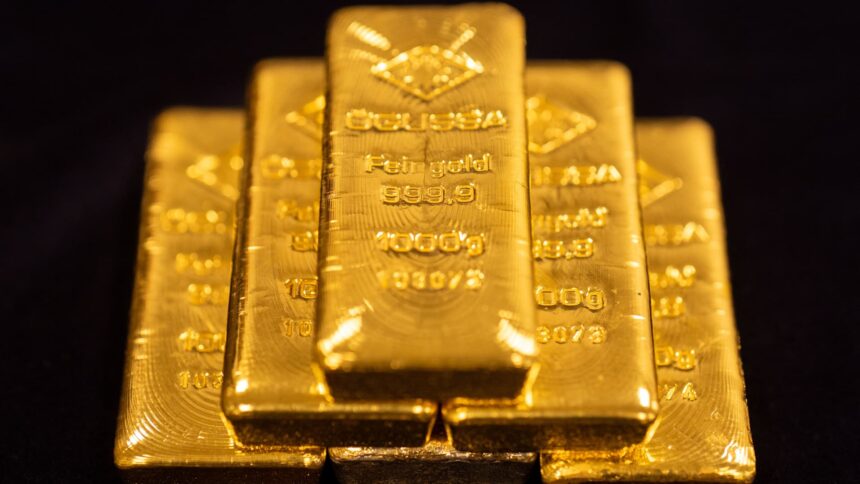
Gold prices slid to a two-month low on Thursday as renewed uncertainty surrounding the U.S.-Iran conflict fueled a stronger dollar and rising oil prices. Spot gold traded about 1.6% lower, settling around $4,385.85 an ounce, while front-month U.S. gold futures dipped by 1.3% to $4,389.70. This drop marked the lowest spot gold price since March 26.
The recent sell-off in gold occurred alongside a strengthening dollar, making the precious metal more costly for international buyers. UBS strategists maintained a bullish outlook on gold despite its current pressure, projecting that the precious metal could rebound as concerns over high energy prices prompt central banks to reconsider tighter monetary policies. They have adjusted their year-end gold price target from $5,900 to $5,500 an ounce, emphasizing gold’s role as a diversification asset within investment portfolios.
Mark Haefele, the chief investment officer at UBS Global Wealth Management, remarked that while short-term fluctuations may be influenced by geopolitical headlines and macroeconomic factors, the medium-term outlook is bolstered by ongoing central bank demand and global economic uncertainties, including high debt burdens and expectations of easier Federal Reserve policies later this year.
Bank of America projected a year-end gold price of $5,093 an ounce, suggesting a potential increase of about 16% from Thursday’s levels, before anticipating a decline to $4,925 per ounce by the end of 2027. Their analysts noted that while gold has been subject to corrections following a surge in exchange-traded fund (ETF) purchases, the broader economic landscape favors its upward trajectory.
Meanwhile, strategists at Kepler Cheuvreux indicated an increased exposure to gold, attributing its correlation to oil prices. The ongoing conflict in the Middle East has continued to raise inflation fears, affecting investor sentiment. Michael Field, chief equity strategist at Morningstar, pointed out that the protracted nature of the Iran war and rising inflation concerns have created a challenging environment for gold, traditionally viewed as an inflation hedge. He noted that the rising interest rates make income-generating assets more appealing compared to non-yielding precious metals.
Government bond yields across Europe, the U.S., and Japan showed slight increases, reflecting anxiety regarding a potential peace deal in the Middle East. The ongoing conflict, exacerbated by the effective closure of the Strait of Hormuz—a vital shipping route—has kept oil prices elevated, further contributing to inflationary pressures.
Silver also faced downward pressure on Thursday, falling 2.4% to around $72.85 an ounce, with futures prices reflecting similar declines. Gold and silver experienced remarkable increases in 2025, with gains of 66% and 135%, respectively, but have encountered significant volatility in 2026, including a major decline in silver futures.
Platinum and palladium followed the downward trajectory, with platinum spot pricing down 1.7% to $1,884.95 per ounce and palladium also falling by 1.7% to $1,366.70. Analysts attributed the collective sell-off of precious metals to a combination of geopolitical tensions and rising interest rates, as well as persistent inflation concerns, exacerbated by surging grocery prices in the U.S. These dynamics continue to create uncertainty in the market as traders anticipate the U.S. personal consumption expenditure price index reading for April, closely watched as the Federal Reserve’s preferred inflation measure. Economists expect a month-over-month increase of 0.5% and a year-over-year rise of 3.8%.