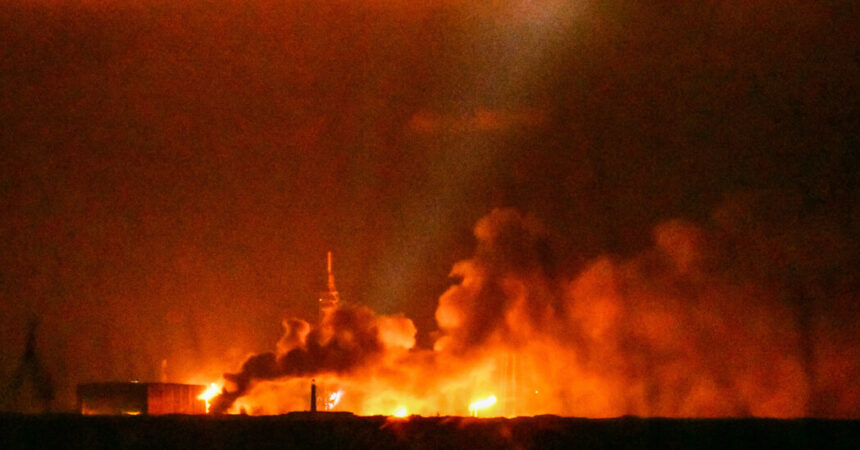
A rocket developed by Blue Origin, the space company owned by Jeff Bezos, suffered a catastrophic explosion on the launchpad in Florida on Thursday night. The incident took place around 9 p.m. during a hotfire test aimed at preparing for an upcoming launch. Blue Origin confirmed the event via social media, stating, “We experienced an anomaly during today’s hotfire test,” while reassuring that “all personnel have been accounted for.”
During the test, the rocket’s seven engines were ignited while the vehicle was held firmly in place on the launchpad. Eyewitness reports indicated that flames quickly engulfed the sides of the rocket, culminating in a powerful explosion that devastated the launchpad and surrounding equipment at the Cape Canaveral Space Force Station. This facility is the sole launchpad used for the New Glenn rocket, which stands at 322 feet tall and is named in honor of John Glenn, the first American astronaut to orbit Earth. Experts anticipate that repairs to the damaged infrastructure could take several months.
The New Glenn rocket was scheduled for a mission to launch 48 satellites as part of Amazon’s Leo initiative, designed to create an internet constellation in low-Earth orbit. However, the Amazon satellites were not aboard the rocket during the test. Jeff Bezos expressed regret over the incident, stating, “It’s too early to know the root cause but we’re already working to find it. Very rough day, but we’ll rebuild whatever needs rebuilding and get back to flying. It’s worth it.”
Elon Musk, the CEO of SpaceX and a rival in the aerospace industry, offered his sympathies through social media, saying, “Sorry to see this, I hope you recover quickly.” The explosion complicates NASA’s plans for upcoming lunar missions which rely on the New Glenn rocket to transport landers to the moon’s surface. Blue Origin is one of two companies contracted by NASA for this purpose, alongside SpaceX.
NASA’s Artemis III mission is set for launch next year, involving a critical exercise of docking an Orion capsule with both SpaceX and Blue Origin landers while in Earth orbit. The destruction of Blue Origin’s launchpad raises concerns about the company’s ability to fulfill its role in the Artemis program.
NASA Administrator Jared Isaacman noted the challenges in spaceflight, particularly with developing new heavy-lift launch capabilities. He pledged to work closely with partners to conduct a thorough investigation into the explosion, assess its impact on near-term missions, and ensure the program’s continuation. “We will provide information on any impacts to the Artemis and Moon Base programs as it becomes available,” Isaacman said.
In an additional complication, a Blue Origin lunar lander, the Blue Moon Mark 1, was scheduled to launch later this year on a New Glenn rocket. Furthermore, NASA recently awarded Blue Origin contracts for two additional New Glenn rockets intended to carry rovers to the moon for the Artemis IV and Artemis V missions set for as early as 2028.
Congressman Mike Haridopolos, representing Cape Canaveral, expressed relief that there were no reported injuries and praised the quick response of local first responders, engineers, and launch teams. He conveyed his prayers for the Florida Space Coast community and everyone involved in the incident.
To date, the New Glenn rocket has completed three launches, with varying levels of success. Its first mission took place in January 2025, successfully placing a test satellite in orbit, although the subsequent booster landing on an ocean barge was unsuccessful. The second launch successfully delivered NASA’s ESCAPADE mission to Mars, while the third reused the booster from the second flight, achieving a successful landing. However, complications during the second stage of the third launch resulted in the payload—a satellite from AST SpaceMobile—ending up in an unintended low orbit, leading to its destruction upon re-entry.