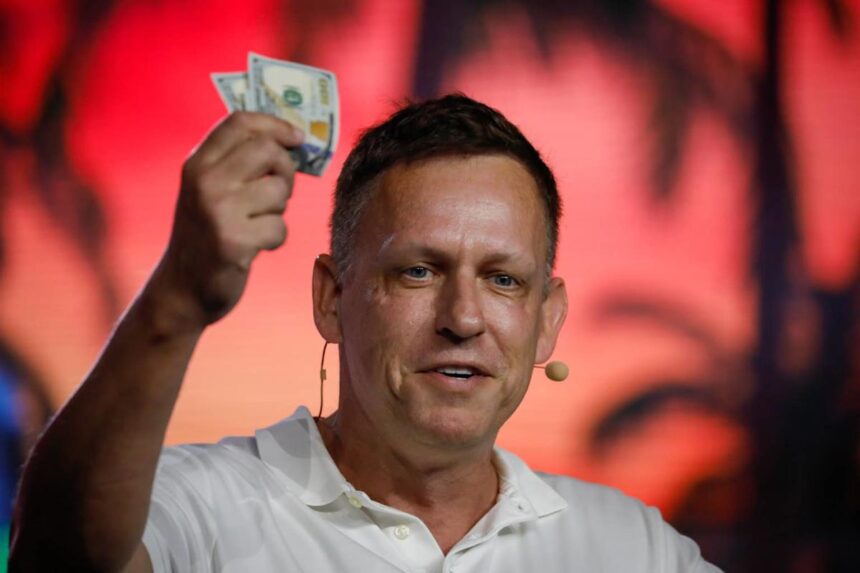
Peter Thiel, the billionaire co-founder of PayPal and Palantir Technologies, has made headlines with his recent relocation to Buenos Aires, Argentina. The move, detailed in a New York Times report, indicates that Thiel has settled into a lavish $12 million mansion in the Argentine capital, where he has also enrolled his children in a local school. This decision appears to be motivated by a combination of tax considerations and broader ideological beliefs, presenting Argentina as a potential refuge from his native United States.
One significant factor influencing Thiel’s relocation is California’s proposed one-time 5% wealth tax on assets exceeding $1 billion. This initiative could impose a staggering financial burden on Thiel, costing him approximately $1.4 billion out of his $28 billion fortune. However, taxation is just one aspect of his strategic planning; unnamed sources suggest that Thiel’s friendship with Argentine President Javier Milei has led to an official offer of citizenship, further enticing him to invest in the South American nation.
While Thiel is actively expanding his international footprint—already possessing passports from New Zealand, Germany, and the United States, and reportedly working towards obtaining a Maltese passport—his primary financial interests still remain heavily tied to the U.S. His acquisition of the mansion in Buenos Aires is, as it stands, his only known venture in Argentina.
The news has caught the attention of the cryptocurrency community, particularly in the context of privacy coins. Following the announcement of Thiel’s move, Will McEvoy, the CIO at Cypherpunk Technologies, emphasized the relevance of Zcash, a decentralized digital currency that offers fully shielded transactions. Zcash operates similarly to Bitcoin, but with the added feature of obscuring details from outside observers.
At the time of reporting, Bitcoin was trading at $73,572, having experienced a slight decline of 0.2%, while Zcash was down over 3%, trading around $536. Both Thiel and Milei are recognized as strong proponents of cryptocurrency. Thiel has openly endorsed Bitcoin, referring to it as “digital gold,” and his Founders Fund has invested $200 million into cryptocurrencies like Bitcoin and Ethereum. Milei, touted as one of the most crypto-friendly leaders globally, has voiced support for Bitcoin as a means to “make money private again,” while overseeing a nation that ranks among the highest for cryptocurrency adoption per capita.
As Thiel navigates this new chapter in Argentina, the implications of his move are being closely watched, particularly in relation to tax reform, citizenship, and the burgeoning cryptocurrency landscape in the region.