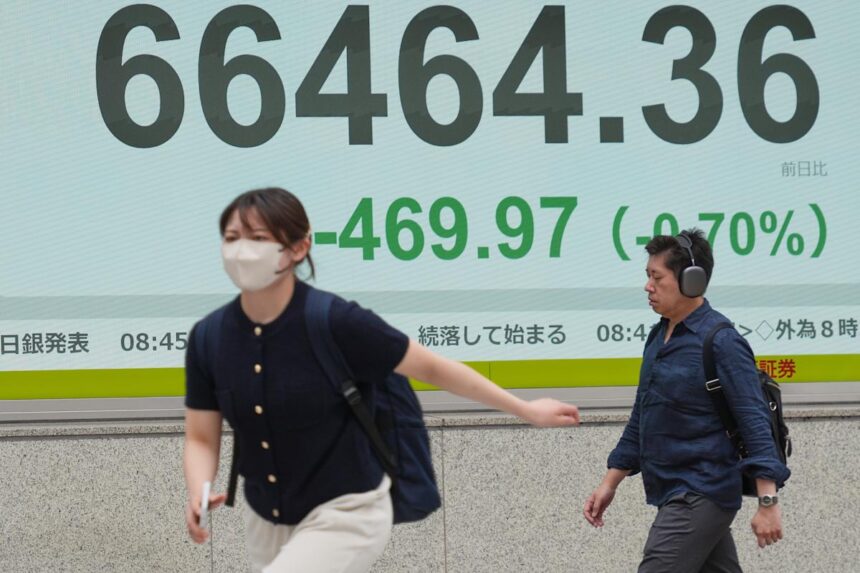
Asian stock markets saw a notable downturn on Tuesday, influenced by escalating tensions surrounding a U.S.-Iran ceasefire. The Nikkei 225 in Japan fell by 1.6%, settling at 65,833.49, while South Korea’s Kospi dropped 1.7% to 8,642.82. In contrast, the Hang Seng Index in Hong Kong managed a modest gain of 1.2% to reach 25,698.75. Meanwhile, the Shanghai Composite index edged down slightly, losing less than 0.1% to close at 4,056.56. Australia’s S&P/ASX 200 also reflected the trend, decreasing by 0.4% to 8,692.20.
In the U.S., futures mirrored these declines, following a day of record highs on Wall Street. On Monday, the S&P 500 had added 0.3% to finish at 7,599.96, while the Dow Jones Industrial Average inched up 0.1% to 51,078.88, and the Nasdaq composite rose by 0.4% to close at 27,086.81. Bond market activity indicated an increase in yields, with the 10-year Treasury yield briefly approaching 4.52% before settling back at 4.46%, up from 4.45% at the end of the previous week.
Rising oil prices appeared to be a significant concern for U.S. companies heavily reliant on fuel, leading to drops in stock prices for major airlines. United Airlines reported a 2.6% decline, while Alaska Air Group fell 3.3%. In early Asian trading, benchmark U.S. crude prices decreased by 39 cents to $91.77 per barrel, and Brent crude, the international standard, slipped by 28 cents to $94.70. Notably, these prices remain elevated compared to the approximate $70 level prior to the escalation of conflicts.
The situation in the Strait of Hormuz—a key oil transit route—remains critical as analysts point out that any resolution between the U.S. and Iran could ease inflation pressures linked to oil prices. Japan, which imports nearly all of its oil, has so far managed to contain the inflationary impact through strategic reserve releases. Analyst Stephen Innes highlighted the broader implications of crude shortages, noting that refiners in Asia and Europe are significantly reducing production, which is impacting vital fuels such as gasoline, diesel, jet fuel, LPG, and naphtha.
On Monday, military developments added to the tension as the U.S. conducted airstrikes against Iranian radar and drone installations following Iran’s downing of an American drone. In retaliation, Iran claims it targeted U.S. soldiers in Kuwait, though the U.S. reported shooting down these missiles. In an effort to deescalate the situation, U.S. President Donald Trump stated that he had urged both Israel and Hezbollah to reduce hostilities during discussions with Israeli Prime Minister Benjamin Netanyahu and through mediators with the Lebanese militant group.
Despite these geopolitical uncertainties, U.S. markets saw positive movement thanks to Nvidia. The tech giant’s stock surged by 6.2% following CEO Jensen Huang’s announcements about product updates at a recent conference, underscoring Nvidia’s significant impact on the U.S. stock market due to its substantial market value.