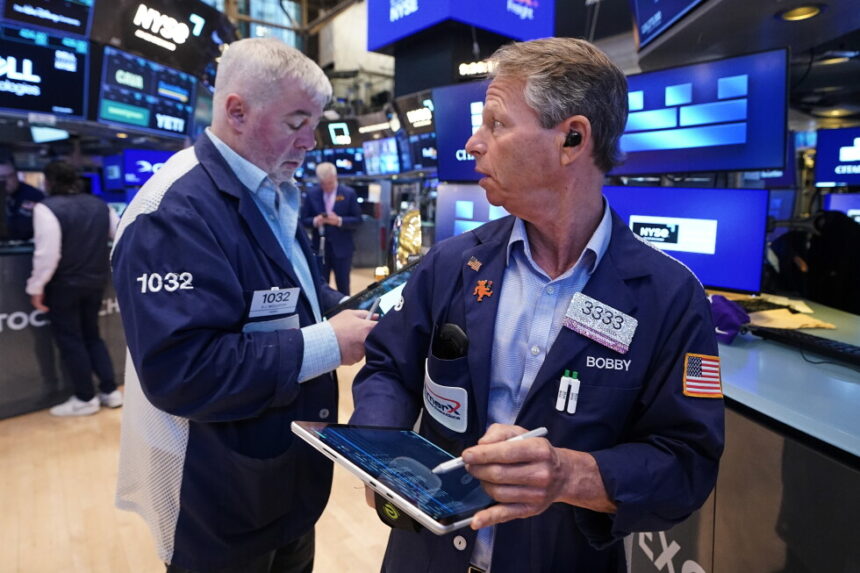
The U.S. stock market is experiencing upward momentum as it approaches new record highs, fueled by the ongoing surge in artificial intelligence (AI) demand. On Tuesday, the S&P 500 rose by 0.2% shortly after reaching an all-time high the previous day. The Dow Jones Industrial Average increased by 153 points, or 0.3%, while the Nasdaq composite also gained 0.2%. All three major indexes managed to recover from earlier morning declines.
Leading the charge are companies specializing in AI chips, as skyrocketing customer demand for computing power continues to drive their growth. Broadcom saw a significant 4.4% increase, while Nvidia added a modest 0.4%. Notably, Marvell Technology experienced a remarkable leap of 29.3%, marking its best performance in three years, after Nvidia’s CEO, Jensen Huang, suggested the company could soon become “the next trillion-dollar company.” This surge follows a recent milestone achieved by Micron Technology, which is also benefiting from the AI boom. Nvidia’s overall market valuation has soared to over $5.8 trillion.
In another success story, Hewlett Packard Enterprise reported earnings that far exceeded analysts’ expectations, leading to a stock surge of 16.1%. The company attributed its strong performance to heightened demand from clients seeking to enhance their AI capabilities.
Generac also made headlines as its stock rose by 5.7% after announcing a deal to supply backup power generators to a major unnamed hyperscale data center operator. These “hyperscalers” are investing heavily in the construction of expansive AI data centers, which industry advocates believe could herald the next significant revolution in the global economy.
Alphabet, the parent company of Google, is raising $80 billion through a stock sale to fund its ambitious plans, which include nearly $190 billion in equipment and investments this year—an amount surpassing the total market capitalization of The Walt Disney Company. Alphabet has indicated that its investment plans for next year will also see significant increases. Despite this, concerns linger regarding the sustainability of the AI boom, as critics have begun to voice worries about a potential bubble in AI investments. This skepticism was reflected in a 2.3% drop in Alphabet’s stock.
Market analysts are noting that the broad U.S. stock market could face a slowdown after an impressive nine-week winning streak for the S&P 500, its longest since 2023. This rally has primarily been fueled by strong profit reports from U.S. companies, as well as optimism surrounding potential agreements between the United States and Iran to reopen the Strait of Hormuz, which could stabilize oil prices.
In the oil market, Brent crude prices rose by 0.9% to $95.82 per barrel, remaining significantly higher than the pre-war level of around $70. Meanwhile, Treasury yields remained relatively unchanged, with the yield on the 10-year Treasury slipping to 4.46% from 4.47%. Despite an initial spike following a report indicating a higher-than-expected number of job listings in April, yields quickly retracted to earlier levels.
Higher global yields are raising concerns about potential impacts on economic growth and stock valuations. This trend has already brought average U.S. mortgage rates to their highest in nine months, posing challenges for corporate borrowing to finance the AI data centers that have recently underpinned U.S. economic growth.
Internationally, stock markets saw positive movements, with indexes rising in much of Europe and Asia. Hong Kong’s Hang Seng Index recorded a notable 2.5% gain, marking one of the most significant increases globally.