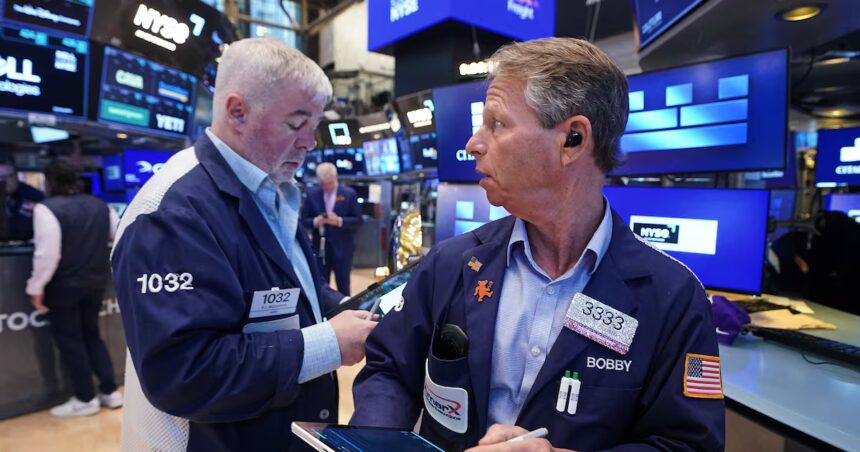
The U.S. stock market remains near record levels as notable gains from companies embracing artificial intelligence (AI) continue to propel indices higher. On Tuesday, the S&P 500 saw a modest increase of 0.1%, marking its latest all-time high just a day prior. The Dow Jones Industrial Average experienced a significant uptick, rising 252 points, or 0.5%, while the Nasdaq composite edged down by 0.1%.
Hewlett Packard Enterprise emerged as a leading force in the market, with its stock surging 17.1% following a quarterly profit that significantly exceeded analysts’ expectations. The company attributed its success to heightened demand from clients investing in AI capabilities. In a more striking move, Marvell Technology’s stock skyrocketed by 29.3%, as Nvidia CEO Jensen Huang suggested at a conference that Marvell had the potential to become “the next trillion-dollar company.” This announcement ignited interest amid growing speculation surrounding AI-driven investments, previously underscored by the surge of Micron Technology into the ranks of AI beneficiaries.
Despite Nvidia’s stock slipping by 0.8%, the company has seen its total market value surpass $5 trillion, solidifying its status as a key player within the AI landscape. Generac also benefited from positive momentum, climbing 6% after announcing a deal to supply backup power generators to a leading hyperscale data center operator. Such hyperscalers are investing heavily in vast AI infrastructure as they seek to capitalize on what many view as a forthcoming transformation of the global economy.
Alphabet, the parent company of Google, is among those hyperscalers. The tech giant announced plans to raise $80 billion by selling shares to fund its expected $190 billion investment in equipment and services this year. This expenditure is projected to exceed the total market capitalization of The Walt Disney Co., raising questions about the actual profit potential that AI investments can deliver. In response to concerns about an investment bubble, Alphabet’s stock fell by 3.3%, becoming one of the most significant drags on the S&P 500.
Analysts are cautious, suggesting that the U.S. stock market may face a slowdown after an impressive nine-week winning streak for the S&P 500. This rally has been fueled by robust earnings reports from U.S. companies and hopes for a potential deal between the U.S. and Iran to reopen the Strait of Hormuz, a move that could stabilize oil prices.
On the oil front, prices are making a recovery after last week’s downturn. Brent crude climbed 1.1% to settle at $96.00 per barrel, significantly above its pre-war level of around $70.
In the bond market, Treasury yields remained relatively stable, with the yield on the 10-year Treasury dipping slightly to 4.45% from 4.47% late Monday. A report indicating that U.S. employers had advertised more job openings than anticipated at the end of April briefly pushed yields higher, signaling continued strength in the labor market. However, yields quickly returned to their previous levels.
High yields globally have raised concerns about their potential impact on economic growth and asset prices. They have already contributed to driving up the average long-term U.S. mortgage rates to their highest in nine months, which could dampen corporate borrowing essential for the development of AI infrastructure that has been a cornerstone of the recent economic boom.
Across international markets, stock indices in Europe and Asia saw gains, with Hong Kong’s Hang Seng index posting a remarkable rise of 2.5%. As the financial landscape evolves, investors will be closely monitoring the interplay between AI investments and broader economic indicators.