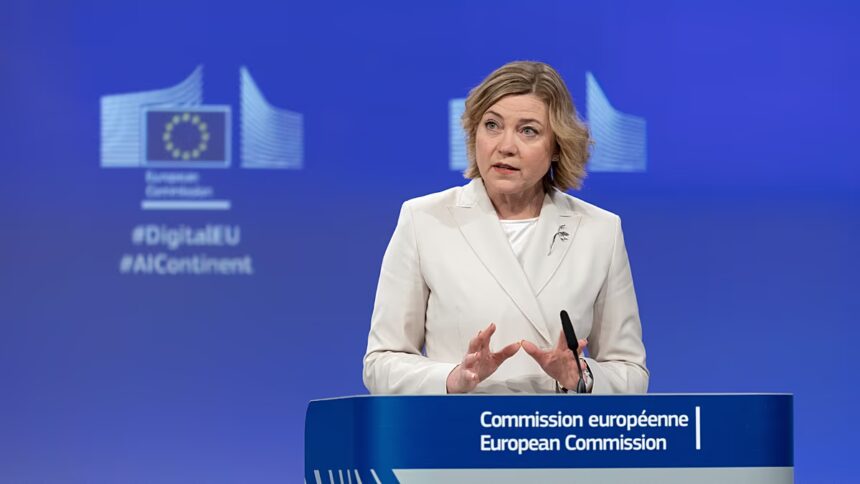
The European Commission has unveiled an extensive tech sovereignty package aimed at enhancing Europe’s technological independence and decreasing reliance on American and Chinese firms. This initiative arises from a recognition that geopolitics and technology are intertwined, with EU officials asserting that Europe must secure a leading role in technological innovation.
The proposal specifically emphasizes bolstering Europe’s domestic tech sector, particularly in areas such as cloud infrastructure, artificial intelligence (AI), open-source solutions, and semiconductor manufacturing. Currently, the European Union (EU) imports a significant portion of its technological services from abroad, with major players like Google, Microsoft, and Apple dominating the digital landscape alongside Chinese companies, including Alibaba and ByteDance, the parent company of TikTok.
The initiative follows a critical report from former Italian Prime Minister Mario Draghi, who highlighted that much of the divergence in GDP growth between the EU and the US can be attributed to advances in digital technologies. Draghi warned that Europe missed out on the initial wave of the digital economy and must capitalize on the emerging transformative potential of AI to remain competitive.
The EU’s dependency on foreign technology has garnered increasing attention, especially in the context of recent geopolitical tensions. The assertive trade policies of the Trump administration and China’s approaches to utilizing such dependencies have sparked fresh urgency for a strategic rethink within Europe.
The heart of the tech sovereignty package is focused on the cloud sector, where current market dynamics heavily favor American firms, which make up roughly 80% of the European cloud market. The draft legislation outlines four tiers of digital sovereignty that public authorities must consider when sourcing cloud services, categorizing them based on the sensitivity of the data involved. The highest tier includes sectors like defense and healthcare, effectively excluding non-European companies from public contracts to mitigate the risks of being cut off from essential services.
German Member of the European Parliament Axel Voss praised this approach as being both bold and pragmatic, stressing the necessity of establishing a genuine European cloud and AI ecosystem, while ensuring local providers have a fair opportunity in strategic public tenders.
Another crucial component of the package addresses the semiconductor industry, vital for manufacturing electronics including AI technologies. The previous Chips Act fell short in significantly reviving semiconductor production in Europe. This new strategy aims to encourage demand for European-made chips, with mandates for sectors like automotive to diversify their chip suppliers and reduce reliance on Chinese manufacturers accused of market dumping.
Central to this package is the focus on AI, which is recognized as a pivotal technology reshaping the digital economy. However, the AI market is currently dominated by US firms like OpenAI and Anthropic. Support from lucrative defense contracts could benefit Mistral AI, the only EU-based entity at the forefront of the AI race.
Despite these efforts, Europe faces significant challenges in meeting the demand for AI services, particularly in data center construction, hampered by regulatory delays, high energy costs, and limited land availability. Critics argue that merely regulating will not suffice; Europe must build its technological capacity to reduce dependencies and provide more choices for businesses and consumers alike.
Moreover, Europe’s participation in the US-led Pax Silica initiative aims to ensure chip supply chain security, acknowledging that in the short term, reliance on NVIDIA chips remains a necessity. This dependency may complicate efforts to create an autonomous European chip ecosystem.
The concept of technological sovereignty has its roots in French defense discourse, evolving to encompass digital technologies due to their dual-use nature. EU policymakers are acutely aware of the potential for retaliation from Washington and Beijing, especially in light of concurrent discussions about strained trade relations. However, insiders suggest that recent behind-the-scenes interactions with the US have been more constructive than public tensions might indicate.
As the EU grapples with these complex dynamics, it remains aware of its critical position within the global chip value chain, particularly through Dutch firm ASML, which monopolizes key machinery required for chip production. The package also emphasizes leveraging open-source technologies to address fragmentation in Europe’s tech landscape, which has thus far failed to yield a company capable of directly competing with Silicon Valley.
Addressing structural issues is crucial for the EU’s tech sector, as well as fostering capital access to mitigate the reasons cited by startups for relocating abroad. The Commission’s EU Inc. proposal and capital markets union aim to address some of these concerns.
Ultimately, while the tech sovereignty package attempts to leverage Europe’s strengths, it acknowledges the impracticality of seeking complete autonomy in the interconnected global economy. Commission leaders set an ambitious vision for progress, targeting visible outcomes by 2030, despite the current reality that 80% of technology flows into Europe from external sources.