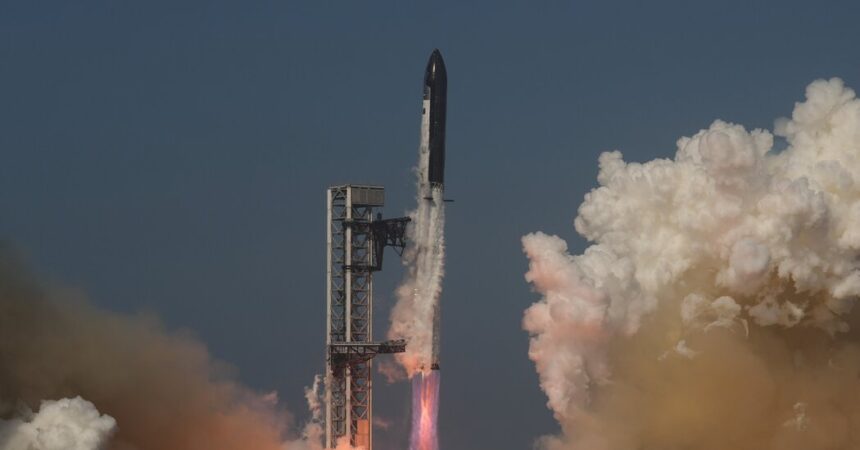
SpaceX, the rocket manufacturer and artificial intelligence firm founded by Elon Musk, has officially set the price for its highly anticipated initial public offering (I.P.O.) at $135 per share. This valuation would propel the company to an impressive $1.77 trillion, making it the largest I.P.O. in history. If the offering goes as planned, SpaceX is expected to raise approximately $74.4 billion, surpassing its previously estimated value of $1.25 trillion as of February.
This announcement positions SpaceX to break the current I.P.O. record held by Saudi Aramco, Saudi Arabia’s state-owned oil giant, which was valued at $1.7 trillion during its 2019 public debut and raised more than $29 billion. Unlike many companies that typically introduce a preliminary price range before finalizing their offering based on investor interest, SpaceX has opted for a straightforward announced price, sidestepping conventional market practices. While revisions are still possible, analysts do not anticipate any changes to the current set price.
Scheduled to debut on the Nasdaq next week under the ticker symbol SPCX, the I.P.O. is uniquely positioned as a significant indicator for upcoming offerings from other industry players, particularly in the artificial intelligence sector. OpenAI and Anthropic are also eyeing public entries, with Anthropic having recently filed confidentially and OpenAI set to follow suit shortly. Each of these companies is valued at close to $1 trillion, suggesting an extensive transfer of wealth that could reshape the landscapes of both Silicon Valley and Wall Street.
The financial windfall from this I.P.O. could be particularly beneficial for Musk, who already holds the title of the world’s richest individual. If the shares reach the projected price of $135, Musk’s stake—approximately 50 percent in the company—would be valued at around $752 billion. However, it’s crucial to note that he is restricted from selling a portion of his shares until certain operational goals are met.
Founded in 2002, Musk’s SpaceX has revolutionized space exploration with its innovative, partly reusable rocket technology and fundamentally altered global communications through its Starlink satellite network. In a recent move, SpaceX acquired Musk’s A.I. firm, xAI, adding another layer to his expanding business empire, which also includes Tesla and multiple other ventures.
Musk has reportedly utilized SpaceX as a financial tool to support various projects within his portfolio, securing loans from the company for personal use. This practice is facilitated by his controlling stake, allowing him to exert significant influence over decisions given his ownership of more than 85 percent of shareholder votes.
Despite past financial opacity, SpaceX recently disclosed its financial standing in an I.P.O. prospectus, revealing a loss of over $4.9 billion last year due to rising A.I. expenditures, in stark contrast to the $791 million profit achieved in 2024. Nonetheless, revenues have surged to $18.7 billion, a 33 percent increase from the year prior.
The funds raised through the I.P.O. are earmarked for ambitious projects aimed at furthering Musk’s vision, such as establishing A.I. data centers in orbit, devising a lunar manufacturing facility, and progressing toward crewed missions to Mars.
Industry experts anticipate that the SpaceX I.P.O. may not only break records but could also pave the way for other monumental public offerings in the near future. The notion of a trillion-dollar valuation at the time of going public has shifted from a rarity to a growing possibility, with analysts like Nicolas Owens from Morningstar implying that further record-breaking I.P.O.s may soon follow suit.