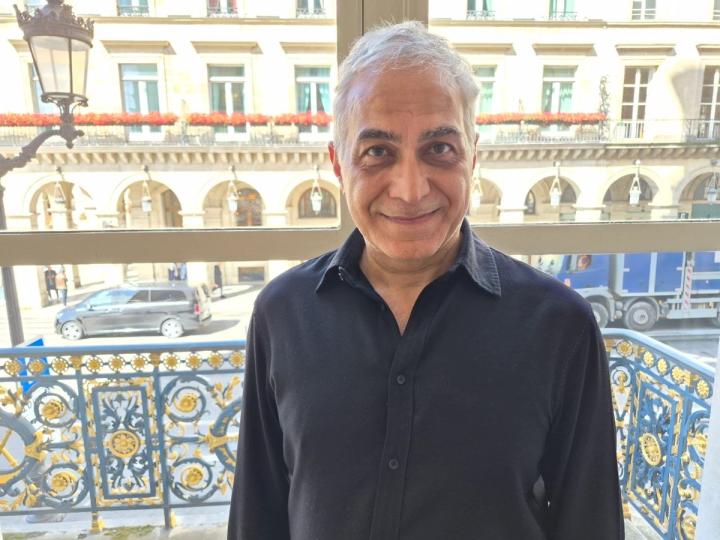
Reza Bundy, the chief executive of Atlas Capital and a business partner of renowned bitcoin skeptic Nouriel Roubini, has expressed a bleak outlook for the cryptocurrency in the coming months. At the Proof of Talk conference in Paris, Bundy stated that he anticipates bitcoin could plummet as much as 70% within the next six months before eventually rallying to as high as $500,000 in the long term. This forecast sharply contrasts with the generally optimistic sentiments prevalent in the crypto industry.
Bundy explicated that the projected decline could see bitcoin dropping to a price range of $26,000 to $30,000, particularly if equity markets experience a downturn similar to the catastrophic decline seen in 2008. He remarked, “If there’s a drawdown in the stock market that’s even half of what happened in 2008, Bitcoin will double that debt loss.” Currently, bitcoin is trading around $63,000, marking a nearly 28% decline this year, even as markets like the S&P 500 and Nasdaq have enjoyed substantial gains, inspired by a surge in artificial intelligence-related investments.
His bearish predictions are grounded in insights gained in collaboration with Roubini, who is infamously known as “Dr. Doom” for accurately predicting the subprime mortgage crisis in 2008. Roubini’s skepticism regarding bitcoin has been consistent since the digital currency’s meteoric rise in 2017, where he deemed it a “pseudo-asset class” and “speculative asset” devoid of genuine value or practical application, contrasting it with traditional economic hedges like gold.
Bundy echoed this critical sentiment in relation to bitcoin’s efficacy as an inflation hedge, asserting that it has instead evolved into a highly volatile risk asset that moves in tandem with technology stocks. This viewpoint resonates with that of billionaire investor Mark Cuban, who has voiced his disappointment with bitcoin’s failure to act as a safe haven during times of economic distress.
Notably, Bundy’s stance on bitcoin isn’t uniformly pessimistic; he retains a long-term bullish perspective on its potential as a store of value. He outlined his belief in bitcoin’s long-term growth, attributed to increasing government debt, reckless monetary expansion, and waning trust in conventional currencies—all concepts envisioned by bitcoin’s elusive creator, Satoshi Nakamoto. Bundy’s optimistic price forecast ranges from $150,000 to $500,000, distinctly diverging from Roubini’s more cynical view.
To substantiate his long-term optimism, Bundy identified four possible economic scenarios that could shape bitcoin’s future price trajectory. The most favorable, “Controlled Expansion” (with a 40% probability), envisions steady global economic growth and stable inflation, pushing bitcoin to between $150,000 and $250,000. Alternatively, a “Fiscal Dominance” scenario (25% chance) may involve significant money printing by governments to manage their debts, elevating bitcoin to a range of $250,000 to $500,000. A “Global Conflict” scenario (20% chance), characterized by major geopolitical tensions, could initially lead to panic-driven price drops but ultimately validate bitcoin as a reliable asset. Finally, a “Deflationary Recession” (15% chance) may weaken bitcoin until central banks intervene with liquidity measures.
In light of his predictions, Bundy indicated a sense of urgency about an impending financial crisis, likening the current stock market to a bubble akin to that of 1929. This perspective underpins the investment strategy of Atlas Capital, referred to as the “techno-dollar.” Rather than linking digital tokens to a depreciating government currency, Bundy emphasized utilizing AI-driven models for asset allocation across domains such as gold, real estate, and defense technology. Currently, the asset allocation strategy is available through an ETF on the Nasdaq, with $18 million in net assets and a return of 8.7% since its inception.
Interestingly, when queried about why bitcoin is not included in this fund despite his long-term bullish outlook, Bundy revealed a cautious approach, stating that he intends to wait for the predicted market correction to conclude before making any decisions regarding bitcoin’s inclusion. “We believe there will be a major stock market correction, and we don’t want to be part of the bitcoin drawdown. Once the correction happens, we will make our final decision to include or not,” he concluded.