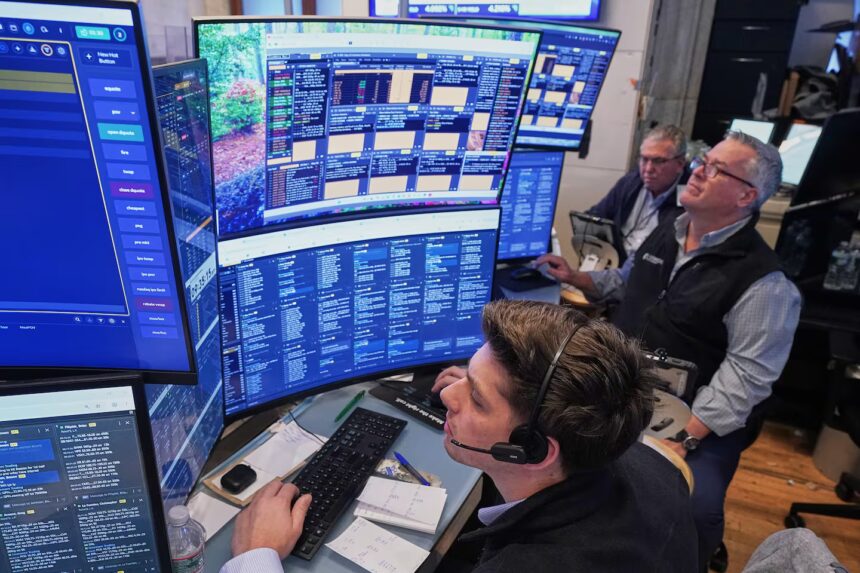
Wall Street is experiencing a significant downturn, heading toward its worst day in nearly eight months. This troubling trend was exacerbated by losses among major technology companies, coupled with a robust jobs report that has raised expectations for potential interest rate hikes by the Federal Reserve later this year.
In late-afternoon trading, the S&P 500 index had dipped by 2.7%, marking its first losing week in the last ten and the largest single-day decline since last October, when trade tensions between the U.S. and China escalated dramatically. The Dow Jones Industrial Average saw a considerable drop, falling 773 points, or 1.5%, while the Nasdaq composite faced an even steeper decline of 4.4%.
Technology stocks played a significant role in dragging down the broader market. Companies that had recently propelled the S&P 500 to record highs are now struggling. Nvidia saw its shares decrease by 6.3%, Broadcom fell by 7.6%, and Micron Technology experienced a notable drop of 12.7%. In a related development, shares of Meta Platforms slid by 6% amid reports that the company might pursue a new stock offering to fund investments in artificial intelligence infrastructure.
While there were nearly equal numbers of gainers and losers within the S&P 500, many of the larger tech firms, often seen as overvalued, bear a disproportionate influence on the market’s trajectory.
On the economic front, bond yields surged following the Labor Department’s report indicating that the U.S. economy added a surprising 172,000 jobs in May. The employment figures, demonstrating resilience amid ongoing inflationary pressures, come just ahead of a pivotal policy meeting scheduled for June 16-17, which will mark Kevin Warsh’s first meeting as chair of the Fed. Analysts widely expect that the Fed will maintain current interest rates at this upcoming meeting, despite ongoing calls from President Donald Trump for lower borrowing costs. However, the market perceives a greater than 60% likelihood that the Fed will raise rates by year-end, with little expectation for rate cuts.
Ronald Temple, chief market strategist at Lazard, commented that hopes for a Fed rate cut have largely evaporated following the strong jobs data. As a result, the yield on the 10-year Treasury rose to 4.54%, while the 2-year Treasury yield climbed to 4.16%.
The Federal Reserve’s current strategy involves holding interest rates steady as it assesses the implications of persistently rising inflation. Prices continue to increase, influenced partly by tariffs impacting imports and disruptions to crude oil shipments due to the ongoing conflict with Iran, which has seen Brent crude prices settle at around $93.09 per barrel, down 2% from previous highs.
Amid these economic pressures, inflation data indicates a 3.8% rise in prices for April—the largest increase in two years. Although Wall Street anticipates that negotiations aimed at resolving the conflict with Iran will eventually bear fruit, uncertainty remains.
In the corporate sector, Lululemon’s shares tumbled by 8.5% after the company revised its revenue and profit forecasts downward. Despite the latest round of corporate earnings reports largely surpassing expectations and contributing to Wall Street’s recent record performance, concerns linger about the long-term viability of tech companies benefiting from the AI boom, potentially indicating an overextension in valuations.
As the earnings season wraps up, analysts caution about a potential market slowdown, particularly as the S&P 500 has risen by 7.7% this year amid various economic challenges. Meanwhile, global markets reflected mixed sentiments, with European stocks fluctuating after a downturn in Asian markets.