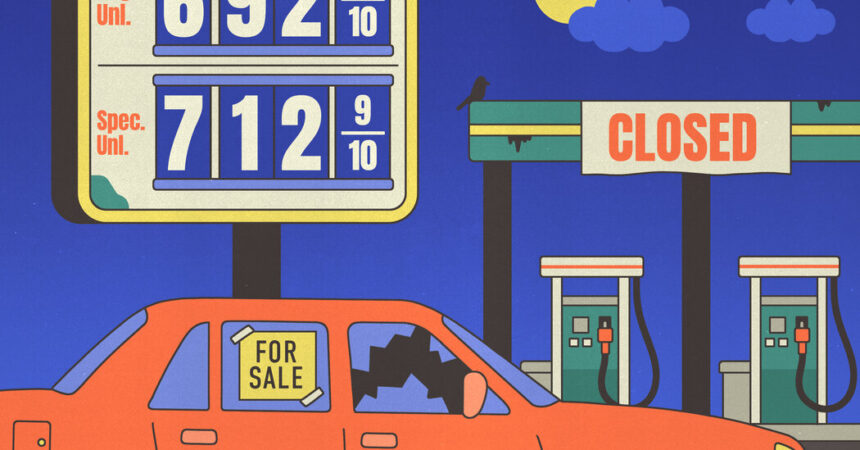
As the war in Iran continues to disrupt traffic through the critical Strait of Hormuz, concerns are growing within the oil industry regarding a phenomenon known as “demand destruction.” This term describes the sustained drop in demand for a commodity, particularly when driven by elevated prices. Market analysts and executives are increasingly worried that falling oil demand could significantly impact global markets.
Recent assessments from Goldman Sachs have indicated that oil prices escalating to $100 a barrel—a level reached periodically since the onset of hostilities on February 28—are strongly linked to notable demand destruction. In a similar vein, the International Energy Agency (IEA) has projected a decline in oil demand by 1.5 million barrels per day for the current quarter, citing that the ongoing scarcity coupled with high prices will likely result in further demand reduction.
Catherine Wolfram, an energy economics professor at MIT’s Sloan School of Management, clarifies that demand destruction is not merely an economic concept but rather a pragmatic observation among traders and industry financiers. In the short term, consumers are feeling the pinch of rising fuel prices which is prompting them to seek alternatives. Many are opting for virtual meetings over commuting, while others are vacationing closer to home to avoid air travel costs.
Some governments are taking proactive measures to curtail energy consumption. For instance, South Korea has encouraged citizens to cycle and take shorter showers, and has mandated that government vehicles remain off the roads one day a week.
On a broader scale, the steps that individuals and governments are currently taking to adapt—such as transitioning to renewable energy sources—could have long-lasting effects on oil demand. Dr. Wolfram notes that those who have switched to electric vehicles (EVs) are particularly pleased with their decision, even though EVs still represent a small fraction of the overall vehicle market in the U.S. Compared to Europe, where fuel prices are higher, American consumers are generally more open to embracing electric transportation options.
However, Dr. Wolfram highlights a troubling aspect: there are still necessary purchases of fuels like gasoline, jet fuel, and diesel, which consumers are compelled to make despite the surging prices. Ryan Kellogg, a professor specializing in energy policy at the University of Chicago, points to the 1970s energy crisis as a historical parallel for sustained demand destruction, which shaped fuel economy standards and led to long-term changes in consumption behavior.
Oil price fluctuations have been notable over recent decades, with previous spikes in 2007 and 2008 and significant crashes at the start of the Covid-19 pandemic. The instability catalyzed by Russia’s invasion of Ukraine in 2022 has reignited volatility in the market. If current price trends continue, consumer behaviors are likely to shift further.
Research from the Federal Reserve Bank of New York suggests that lower-income consumers are already beginning to scale back on gasoline purchases, an early indicator of demand responses to rising prices. Even if the situation at the Strait of Hormuz improves in the near future, it’s unlikely that prices will stabilize quickly. Factors such as damaged refineries in Iran, which are critical for gasoline and jet fuel production, will require time and investment to repair.
As Dr. Wolfram inquires, “Can people afford these higher prices?” The ongoing war and the subsequent economic implications highlight the urgent need for practical alternatives. The hope is that these alternatives are both viable and acceptable to consumers navigating an increasingly challenging energy landscape.