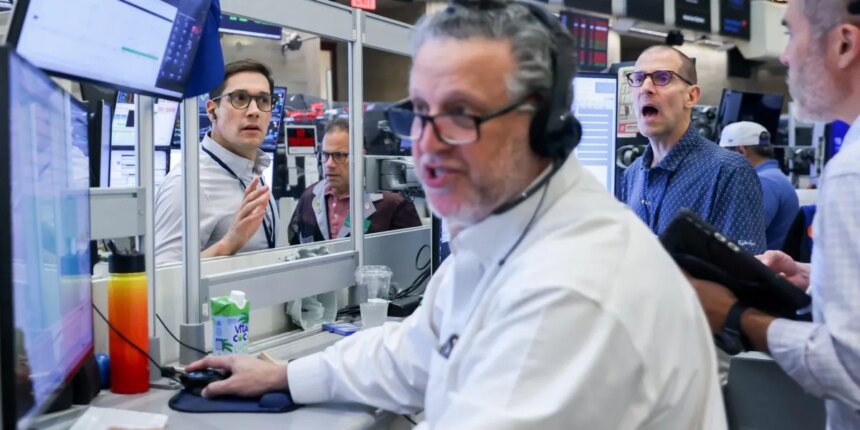
The U.S. labor market showcased remarkable strength in May, significantly outperforming analysts’ expectations. Payroll gains soared to nearly double what economists had predicted, signaling a robust economy. However, this positive news was overshadowed in the stock market, particularly within technology sectors, with the Nasdaq experiencing a dramatic fall of 4%, marking its worst day in over a year. The S&P 500 also felt the impact, declining by 1.2%.
The White House expressed confusion regarding the market’s reaction. President Donald Trump took to Truth Social, asserting that a strong jobs report should correlate with rising stock prices, reflecting an economic principle that has seemingly held true for two centuries. He emphasized the notion that economic growth does not inherently lead to inflation.
Several factors are contributing to a “hot” demand environment. Overall consumer spending surged by 5.9% in the last quarter, which exceeds the Federal Reserve’s inflation target growth rate of approximately 4%. This demand surge is being hampered by multiple supply chain challenges, including disruptions from the war in Iran, which has severely affected oil shipments through the Strait of Hormuz, leading to rising gas prices. Additionally, tariffs on imports have escalated costs, while a shrinking labor force—partially resulting from immigration policies of the Trump administration—adds further complications.
The current economic landscape illustrates a classic formula for inflation: strong demand coupled with limited supply. Consumer prices have exceeded the Fed’s 2% inflation target for over five years, prompting a reevaluation of how growth is interpreted in financial markets. In a context of abundant supply, strong job reports suggest more output and potential profits. Conversely, constrained supply implies that increased spending power is hitting against a ceiling of inflation, leading to concerns that the Fed might have to raise interest rates rather than lower them.
The rising interest rates are exerting significant pressure on equity valuations, particularly within the technology sector. With the growing demand for capital driven largely by advancements in artificial intelligence, tech giants are poised to invest close to a trillion dollars annually in data centers and chips. Nonetheless, this demand is met with climbing borrowing costs. Following the jobs report, the 10-year Treasury yield surged to 4.54%, with the 30-year Treasury surpassing 5%. Futures markets now reflect a greater than 60% probability of a rate hike by the end of the year.
The challenge arises from the nature of equities as long-duration assets. Stocks are not merely evaluated by current profits but are inherently tied to future earnings projections discounted to present value. As interest rates rise, the present value of future profits diminishes. Consequently, technology stocks, often valued based on anticipated revenues several years out, become particularly vulnerable under these conditions.
For example, prominent memory chip manufacturers such as Marvell and Micron saw their stock prices drop by 9% following the report, in stark contrast to the 0.3% decline in the Dow. This shift indicates a rotation of investor interest from growth-driven tech stocks to more established companies with immediate profit returns, like Coca-Cola and Colgate-Palmolive.
Research from Barclays indicated significant stress as interest rates near 5%, a level they deem critical for equity valuations. While Friday’s market reactions may imply caution in the AI sector, it does not necessarily signal its demise; rather, it represents a reassessment of valuations based on increasing discount rates.
Despite this turbulence, the pressure may create favorable conditions for upcoming IPOs. The initial public offering market is gearing up for a busy summer, with notable companies like SpaceX poised to set records. Analysts are monitoring the potential for oversupply in the market but view the recent decline as a potential corrective measure.
Market experts noted that the selloff was not surprising, particularly in light of recent economic signals and their impact on investor psychology. The current environment reflects both a necessary recalibration and an opportunity for strategic investment, especially in high-potential sectors poised for growth in the long term.