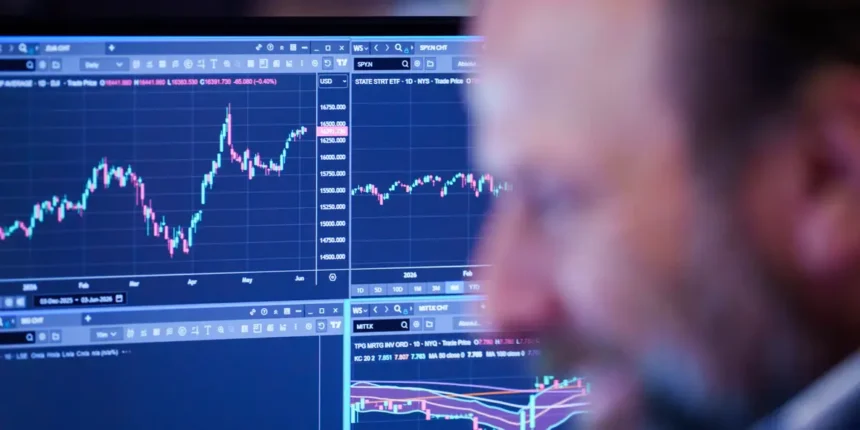
The S&P 500 experienced its most significant drop of 2026 on Friday, marking a challenging period for investors, while the Nasdaq concluded its worst week since the notable tariff rout on Liberation Day. Despite the alarming downturn, Michael Wilson, Chief Investment Officer at Morgan Stanley, asserted that this pullback could serve as a “healthy reset” for the market. Wilson maintains a positive outlook, keeping his year-end target for the S&P 500 at 8,000, suggesting a potential upside of 7.5% from Monday’s opening. He emphasized that despite Friday’s sharp decline, strong earnings and macroeconomic data remain robust and could foster broader market participation in the coming months.
The most recent data indicated a stronger-than-expected jobs report, which diminished any anticipations of the Federal Reserve cutting interest rates this year. This sell-off halted a nine-week winning streak for the stock market. The decline was primarily driven by semiconductor stocks, with the iShares Semiconductor ETF experiencing its most substantial daily losses since March 2020, despite it being up over 80% year-to-date. Wilson noted that substantial year-to-date gains combined with crowded positions among hedge funds and leveraged ETFs likely exacerbated the sell-off.
“The trajectory for markets moving forward will rely on how quickly positioning normalizes, alongside the trends in rates, rate volatility, oil prices, and the US dollar,” Wilson explained. Following Friday’s downturn, the chip ETF showed signs of recovery, bouncing back in Monday’s trading session, which also saw the tech-heavy Nasdaq lead major indexes upward.
Market experts on Wall Street echoed Wilson’s sentiment, suggesting that the volatility observed on Friday should not incite worry. Eric Freedman, Chief Investment Officer at Northern Trust Wealth Management, characterized the situation as a “glass-half-full” scenario for diversified portfolios. He noted that the S&P 500 had surged 20% since late March, which had resulted in a steady upward trajectory prior to the recent sell-off. Both Wilson and Freedman highlighted that strong earnings will likely support a continuing bull market as the year progresses.
Despite rising concerns regarding the possibility of an “AI bubble” in earnings, Nancy Tengler, CEO and CIO at Laffer Tengler Investments, countered the narrative. “If we’re in a bubble, then it’ll pop, but I’m not convinced we’re there yet,” she stated, noting that an amount of skepticism among investors is healthy as markets often climb amidst uncertainty. Tengler emphasized that the prevailing flight towards innovative sectors could be driving the current market dynamics.
Nevertheless, Morgan Stanley indicated that while further gains for the S&P 500 seem plausible, various risks remain on the horizon for the bull market. Key factors include interest rates and their volatility, tied to forthcoming inflation data and the Federal Reserve’s liquidity measures. The 10-year bond yield currently stands at 4.51%, a level Wilson has highlighted as potentially bearish for equities. Upcoming announcements regarding interest rates will take place on June 17 during the Federal Open Market Committee meeting, with current market projections favoring a rate increase by year-end—marking a significant shift from earlier expectations of potential rate cuts.
Investors are expected to receive new insights into inflation trends this week, with the Consumer Price Index report scheduled for Wednesday and the Producer Price Index reports set for Thursday.