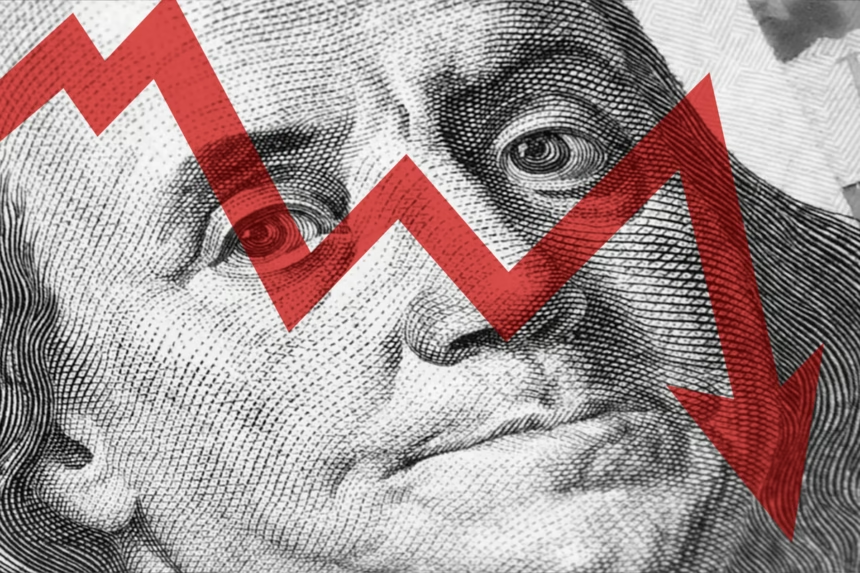
On Friday, June 5, the stock market experienced significant declines, with the S&P 500 retreating by 2.6% and the Nasdaq Composite dropping 4.1%. This downturn followed an unexpected surge in payroll numbers, which indicated that job growth has now exceeded 100,000 for three consecutive months—an achievement not seen since early 2024. While a strong labor market is typically viewed as positive news, this time it spurred fears among investors, particularly because inflation recently reached a multiyear high. As a result, the anticipation for interest rate cuts by the Federal Reserve has all but vanished, and many are now bracing for potential rate hikes.
Current projections suggest that the Federal Reserve may raise interest rates by half a percentage point over the next 15 months. Earlier this year, market indicators pointed to two quarter-point rate cuts by December 2026, reflecting a starkly different economic scenario. Investors are now pivoting to forecast the likelihood of two quarter-point rate hikes by September 2027. The shift can largely be attributed to a robust labor market, which saw the U.S. economy adding 569,000 jobs this year, a significant jump from just 116,000 jobs added in the previous year, largely impacted by trade uncertainties.
Experts, such as Wells Fargo’s senior economist Sarah House, attribute the current job market resurgence to an improved economic outlook, noting that “employers have a better sense of the growth backdrop” as uncertainties from previous presidential tariffs have lessened.
Inflation, however, remains a concern. The Consumer Price Index (CPI) recorded a year-on-year increase of 3.8% in April, the highest level since May 2023. Preliminary data suggests that CPI inflation may have surpassed 4% in May, although the official data will be released on June 10.
The Federal Reserve operates under two primary mandates: maintaining stable prices while maximizing employment. With a resilient job market, the Federal Reserve has more latitude to raise interest rates without the immediate risk of triggering a recession.
Historically, when the Federal Reserve has initiated rate hikes, the stock market has exhibited a tendency to decline in the subsequent three months. An analysis of previous rate-hiking cycles since 1999 shows that the S&P 500 and Nasdaq Composite typically recorded average declines of 7% and 8%, respectively, during this period. For instance, the stock market faced substantial drops following rate hikes in June 1999 and March 2022, where the S&P 500 fell by 17%.
The reasoning behind this trend lies in the economic fundamentals; higher interest rates result in increased borrowing costs that can suppress consumer spending and raise expenses for businesses, leading to reduced corporate profits. Consequently, stock prices—closely tied to these profits—often experience downward pressure.
Moreover, the allure of bonds becomes stronger as interest rates rise. In May, yields on 30-year Treasury bonds soared to 5.18%, levels not seen since July 2007, a time when both major stock indices experienced notable declines over the following year.
Despite the historical tendency for higher interest rates to correlate with stock declines, such drops have generally been moderate and did not qualify as market crashes. However, the recent spike in Treasury yields has heightened apprehension among investors, particularly in the context of geopolitical tensions, such as the ongoing conflict in Iran, which has significant implications for oil supply and may drive core inflation upward.
Should these conflicts continue and lead to lasting increases in core inflation—by raising the costs of production and transport—the Fed might adopt a particularly aggressive approach to interest rate hikes. This scenario poses a risk that could exacerbate market volatility and potentially lead to a more severe downturn. Investors are urged to remain vigilant amid these evolving economic conditions and to consider the implications of potential Fed actions on the market landscape.