The S&P 500 has seen impressive gains under former Federal Reserve Chair Jerome Powell, achieving an annual return of 12.7%, the best performance since Paul Volcker’s tenure began in 1979. Despite this, President Donald Trump has consistently criticized Powell and other Federal Reserve officials for maintaining high interest rates. Trump’s discontent did not stay confined to public remarks; following his return to office, the Justice Department initiated criminal investigations into Powell and Fed Governor Lisa Cook, raising concerns among economists about potential damage to the credibility of the central bank.
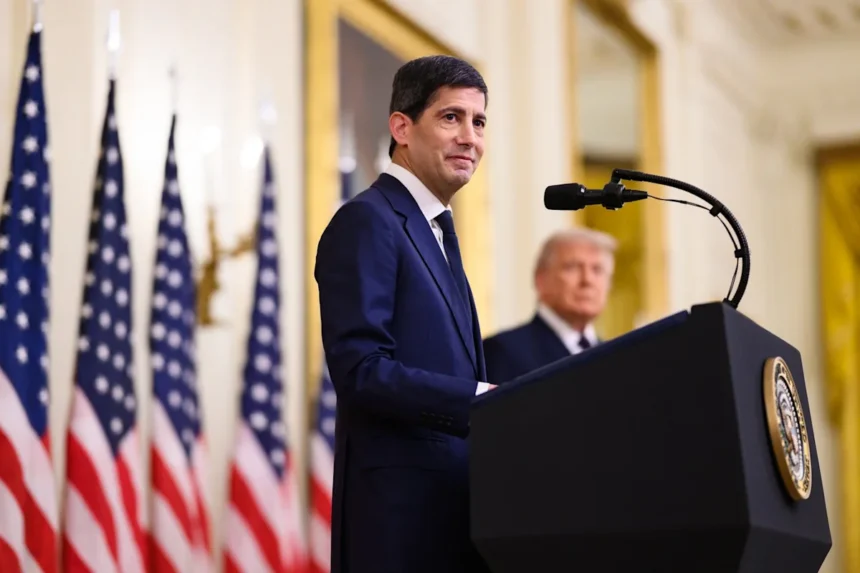
Amid this politically charged environment, Kevin Warsh, a former Fed governor who has advocated for lower interest rates, has stepped into the role of Fed chair after being nominated by Trump. Warsh’s tenure has been marked by a desire for changes in monetary policy, which he argues should adapt to the deflationary pressures brought on by artificial intelligence (AI). He believes the Federal Reserve is operating on outdated economic models that fail to reflect the cost-reducing benefits of AI technologies, which he claims are driving prices down. Warsh has suggested that initial reforms could include a rate cut as a step towards a broader transformation of Fed policies.
However, Warsh’s proposed changes come at a time of escalating inflation concerns, particularly due to rising energy prices tied to ongoing conflicts in Iran. Recent data indicated a CPI inflation rate of 3.8% in April, its worst in three years, with forecasts suggesting an increase above 4% in the following months. In this fraught economic landscape, any move by Warsh to cut rates could be met with significant skepticism from investors, who might fear that such decisions have been unduly influenced by political considerations.
The potential fallout from politically motivated monetary policy could disrupt the stock market. Investors may question the Federal Reserve’s independence, with concerns over decisions aimed at politically expedient outcomes rather than long-term economic stability. Such perceptions could lead bond investors to seek higher yields in response to perceived risks, thereby creating a downward pressure on stock prices as higher bond yields draw money away from equities and compress stock valuations.
Warsh also advocates for shrinking the Fed’s balance sheet as a complementary strategy to offset the inflationary risks associated with rate cuts. The central bank’s assets have ballooned from $900 billion in 2007 to $6.7 trillion today, largely due to bond purchases aimed at stabilizing markets following the 2008 financial crisis. Warsh argues that, unlike broad-based rate cuts that may favor holders of financial assets, shrinking the balance sheet impacts the entire economy more equitably.
However, amidst these proposals, the specter of political interference remains a persistent concern. If investors perceive rate cuts linked to political pressures, particularly in light of Trump’s ongoing public criticism of the Fed, it could lead to severe repercussions for the stock market. Warsh finds himself navigating these complicated dynamics as he balances his policy objectives with the imperative to maintain the Federal Reserve’s independence.
As market participants weigh these developments, caution is advised for investors. While the potential for growth remains, evaluating the landscape is essential before making significant investment decisions. Recent reports suggest that top analysts have identified alternative stocks that might outperform the S&P 500, highlighting the importance of strategic investment choices amidst potential volatility in the broader market.