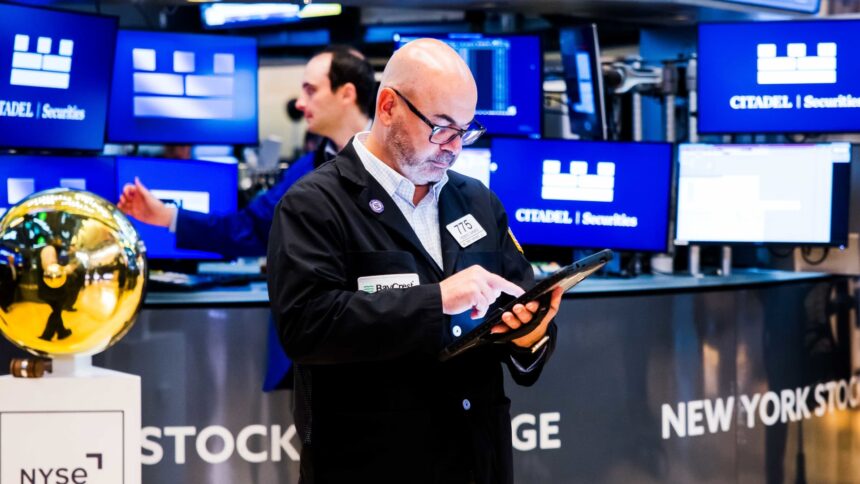
Traders observed notable volatility in financial markets on Wednesday night as tensions escalated between the U.S. and Iran, following fresh military strikes ordered by President Donald Trump. Following these developments, stock futures fell sharply, with S&P 500 futures down 0.4% and Nasdaq 100 futures decreasing by 0.6%. Dow Jones Industrial Average futures also experienced a decline, losing 123 points, or 0.3%.
In response to the geopolitical unrest, oil prices surged, with West Texas Intermediate (WTI) crude futures rising nearly 3% to approximately $92 per barrel. This increase can be attributed to both the manmade tensions and the undercurrents from the oil market responding to disrupted expectations concerning supply and demand dynamics.
Asian markets reflected similar concerns as they opened lower on Thursday. South Korea’s Kospi index led the losses, plummeting 4.1% in early trading. Japan’s Nikkei 225 experienced a notable downturn of 2.3%, while Australia’s S&P/ASX 200 was down by 0.97%.
Adding to the negative sentiment in the markets, Oracle’s shares fell more than 11% in extended trading after the company announced plans to raise an additional $20 billion in equity and debt specifically aimed at funding its artificial intelligence initiatives. This sharp drop weighed heavily on S&P 500 futures and the iShares Expanded Tech-Software Sector ETF (IGV), suggesting potential losses within the tech sector in the impending trading session.
The situation in the Middle East intensified as U.S. Central Command forces disclosed on social media that they had conducted additional “self-defense strikes” against Iran. Reports indicate that these military actions were executed under President Trump’s directive. Earlier in the day, the U.S. markets faced a significant sell-off resulting from a slump in the chip sector coupled with the rising geopolitical tensions. The Dow lost 953.33 points, or 1.87%, while the S&P 500 and Nasdaq Composite fell by 1.62% and 1.98%, respectively.
Market analysts are observing a trend where investors are rotating their portfolios in response to the tech sector’s dominant performance this year, with a focus on identifying safer alternatives. Victoria Fernandez, chief market strategist at Crossmark Global Investments, noted that investors are looking for areas to hedge against the tech momentum. There’s been increased interest in sectors such as healthcare, particularly pharmaceuticals and biotech, as well as in financials and energy.
The already fragile ceasefire between the U.S. and Iran faced further jeopardy as President Trump criticized Tehran for prolonged negotiations regarding a potential deal, indicating that stricter measures would follow if an agreement was not promptly reached. He stated that the U.S. would be “attacking them very hard,” sending ripples of anxiety through financial markets.
Investors will be closely monitoring upcoming economic data as well, including the producer price index (PPI) report scheduled for release on Thursday at 8:30 a.m. ET. Economists are expecting a 0.7% increase in wholesale inflation, and a 0.5% uptick in core inflation, which excludes volatile food and energy prices. These figures are anticipated to be below April’s increases, suggesting a potential easing in inflationary pressures. Additionally, traders will be keenly awaiting initial jobless claims data for the week ending June 6, which could provide further insights into the labor market dynamics amidst these turbulent economic conditions.