In a notable milestone for the investment landscape, the Vanguard S&P 500 ETF (VOO) has become the first exchange-traded fund (ETF) to surpass $1 trillion in assets, marking a significant achievement in the realm of index funds. This surge in popularity reflects a broader trend as substantial inflows into index ETFs show no signs of abating.
The Vanguard ETF is not alone in this growth. Other significant players in the S&P 500 category are also seeing substantial assets, with the SPDR S&P 500 ETF Trust (SPY) nearing $800 billion and the iShares S&P 500 ETF (IVV) already exceeding that mark. Additionally, the Vanguard Total Stock Market ETF (VTI), while slightly different, is close behind with more than $660 billion in assets. This accumulation emphasizes a remarkable trend: the continuous influx of capital into index-focused investments, signaling a shift towards passive investment strategies.
In a broader context, this marks a transformative period in the fund industry, with passive investments increasingly overshadowing their active counterparts. Analysts predict that passive fund ownership could eventually dominate, possibly capturing 70-80% of the market. Yet, it’s essential to observe that while passive funds are growing, they still represent a relatively small portion of overall market ownership.
Amidst this growth in passive investing, retail trading has also seen a significant uptick in recent years. Since 2020, a surge in new retail investors has been recorded, notably spurred by the financial stimulus measures introduced during the pandemic. This growth marks a stark contrast to the passive investment trend, showcasing an evolving landscape where both substantial amounts of money flow into passive investments, while increasing numbers of retail traders engage in speculative market activities.
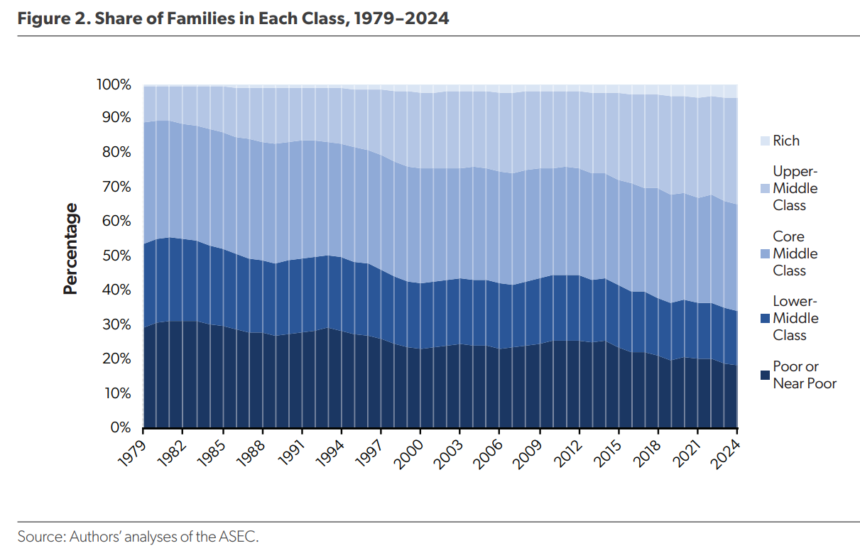
In a broader socio-economic context, recent data highlights a complex narrative regarding wealth distribution in the United States. A report from the American Enterprise Institute illustrates a shrinking middle class, which paradoxically reflects an upward mobility trend as more individuals transition into the upper middle class.
From 1979 to 2022, the percentage of American households classified as lower middle class has decreased from 24% to 16%, and the percentage considered poor or near-poor dropped from 30% to 19%. Conversely, the upper middle class has expanded from 10% to 31% during the same period. While this suggests positive economic mobility, the wealth gap has also widened, with the richest households reaping disproportionate increases in wealth.
A New York Times op-ed highlights shifts in wealth distribution, noting that the middle class’s share of wealth has drastically reduced from 24% in 1989 to just 8% in 2022. Likewise, the upper middle class has seen its share decrease from 50% to 39%. In stark contrast, the wealthiest households—comprising only 3% of the population—have seen their wealth share more than double to 53%.
This dual narrative illustrates that while many households have improved their economic positions, the wealthiest have gained even more, complicating discussions on inequality and economic progress. The increasing divergence highlights the nuance often missed in public discourse, suggesting that wealth can grow for many while still amplifying inequality at the top.
Amid these developments, conversations around investment behaviors and wealth disparities continue to evolve. The coexistence of record inflows into passive funds alongside increasing retail speculation presents a complex picture of modern investing, challenging traditional notions of market participation and wealth distribution.