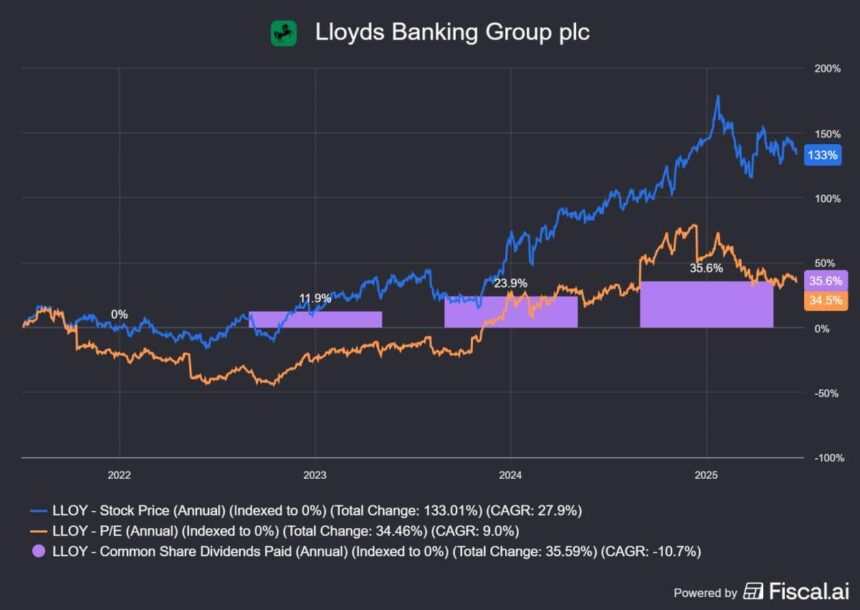
Lloyds Banking Group’s shares present a compelling case for those seeking reliable income stocks. At first glance, the company appears to embody the quintessential UK income investment, featuring a low valuation and a respectable dividend alongside its extensive retail presence. However, a deeper dive reveals that the narrative might be more complex, resembling a macroeconomic play rather than a straightforward income opportunity.
As the largest retail bank in the UK, Lloyds commands a significant 16.8% share of the country’s mortgage market, translating into £52.7 billion in loans. Given this heavy reliance on the UK mortgage system, the question arises: is Lloyds a true income stock or merely a proxy for fluctuations within the British housing cycle?
### Income Stability vs. Macroeconomic Sensitivity
In periods of rising interest rates, Lloyds stands to benefit, as higher rates allow the bank to earn more on new mortgages and associated loans. Conversely, when rates decline, the bank faces risks related to squeezed margins and potentially slower lending growth. Recently, interest rates fell from 4.25% in May 2025 to 3.75% in early 2026—the lowest level since late 2023—prompting Lloyds’ shares to elevate to multi-year highs during 2024 and 2025. Analysts have responded by upgrading the stock, with price targets now in the mid-80p range.
Despite these positive indicators—such as a 5% increase in loans and advances, reaching £481.1 billion in 2025—the sustainability of this optimism is uncertain.
### Hidden Risks and Challenges
Potential rate cuts present a significant risk to Lloyds’ net interest margins. The bank is also navigating possible challenges within the UK property market and rising unemployment, both of which could strain borrowers. Should property prices decline, Lloyds may find its risk-weighted assets escalating and capital buffers tightening as a result.
Another major complication stems from a recent motor finance scandal that has deeply impacted the bank’s finances. Lloyds added £800 million in charges related to this scandal, bringing total provisions to £1.95 billion. The issue has already cost the bank around £22 billion due to historical mis-selling practices, with the Financial Conduct Authority estimating that 44% of motor finance agreements since 2007 may be liable for compensation. In a decisive move, Lloyds opted not to contest the FCA’s compensation scheme, anticipating payouts to 14 million customers totaling approximately £8.2 billion.
### Investor Considerations
For investors assessing Lloyds as a reliable income stock, it is crucial to keep a close watch on UK interest rates and the resilience of the housing market. Should the mortgage sector remain robust and rates do not plummet, Lloyds could continue its trajectory of growth. On the other hand, softer housing market conditions could lead to more cyclical behavior rather than the stable dividend income many investors seek.
Currently, Lloyds presents some appealing financial metrics: a share price around 98.5p, a market capitalization of £57.12 billion, and a price-to-earnings ratio of 14.03. The bank anticipates a dividend of 3.33p per share for 2025, signaling a 15% growth, with a dividend yield between 3.25% and 3.39%.
### A Cautious Investment
Lloyds could very well serve as a proxy for the UK mortgage cycle, introducing additional macroeconomic risks into the equation. The share price is closely linked to housing trends, Bank of England policies, and credit quality. For those UK income investors feeling optimistic about housing prospects, the bank’s reliable dividend yield is attractive. However, it must be noted that this is not a risk-free investment. Investors who harbor concerns about housing market stability may find more secure options in regulated utilities like National Grid or United Utilities.
In terms of informed investing, insights from seasoned analysts suggest that potential investors should consider Lloyds along with other standout stocks that might align better with individual financial goals and market outlooks.