Every year, individuals engaged in investment planning often undertake an exercise to evaluate their financial goals and strategies. This process typically involves analyzing current net worth and savings rates, while also making informed assumptions about future income and expected returns. Given the unpredictable nature of financial markets, these return expectations span a range rather than a fixed number. By modeling financial scenarios extending over 5, 10, 15, and even 20 years, investors aim to establish road markers that guide their planning efforts throughout their financial journeys.
It’s important to recognize that such planning is not about achieving absolute certainty; instead, it serves as a framework for assessing financial health. Historical performance confirms that assumptions will often prove incorrect, given the inherently lumpy nature of market trends. This often becomes apparent when comparing projected outcomes with actual financial data over time.
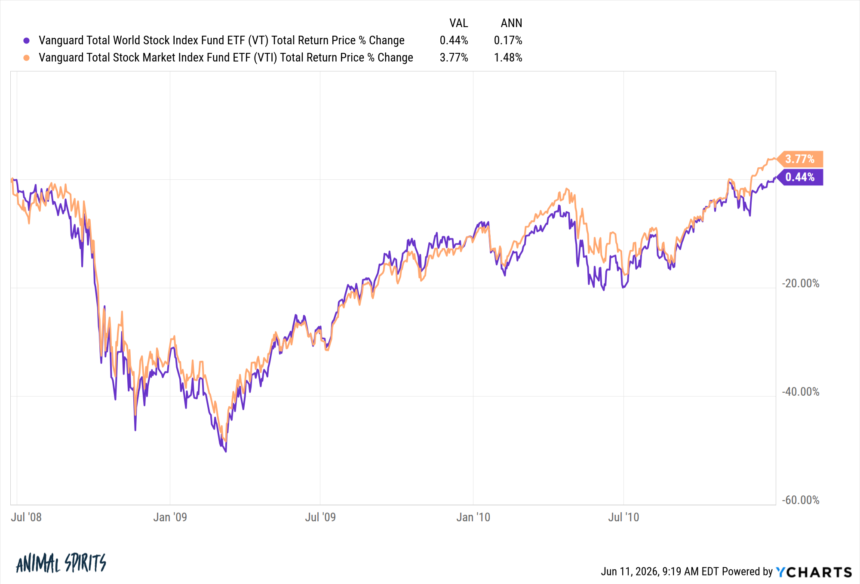
For instance, an analysis of returns during the initial years of investment planning might reveal significant shortfalls due to adverse market conditions, such as a major stock market downturn. Considerations about the implications of the Great Financial Crisis underscore this; during that tumultuous period, the market saw declines of nearly 60%, severely impacting investment returns. This was evident from 2005 to 2010, when a bear market resulted in lackluster progress despite ongoing retirement contributions.
However, the landscape shifted dramatically post-2009. Since then, the S&P 500 has shown robust annual gains, averaging more than 15%. A diversified global stock portfolio has fared well too, with returns around 12% annually. Notably, the U.S. stock market recorded an impressive increase of 16.9% annually from the market’s nadir in early 2009. Such extraordinary outcomes were certainly not accounted for in the original return assumptions utilized in financial planning.
Despite the substantial growth of their investment portfolios, individuals rightly refrain from attributing this success solely to their abilities as investors. The consistent uptrend in the markets does not equate to greater forecasting acumen; rather, it highlights the role of market dynamics over personal strategy. Importantly, periods of bull markets do not inherently reflect intelligence, just as downturns do not signify incompetence.
Investor emotions often complicate this landscape, where highs may breed overconfidence and lows can induce doubt about long-term strategies. The uncertain nature of bull markets emphasizes that neither prolonged uptrends nor sudden declines define investment wisdom. As a result, investors are reminded of the importance of maintaining perspective through documented intentions and rational foresight.
This approach stresses the value of process over outcomes, minimizing the tendency to react solely based on market fluctuations. Writing down strategies, expectations, and rationales serves as an effective tool for grounding decisions in a consistently evolving market environment. As investment landscapes fluctuate unpredictably, adhering to a structured and reflective planning process can provide stability amidst uncertainty.