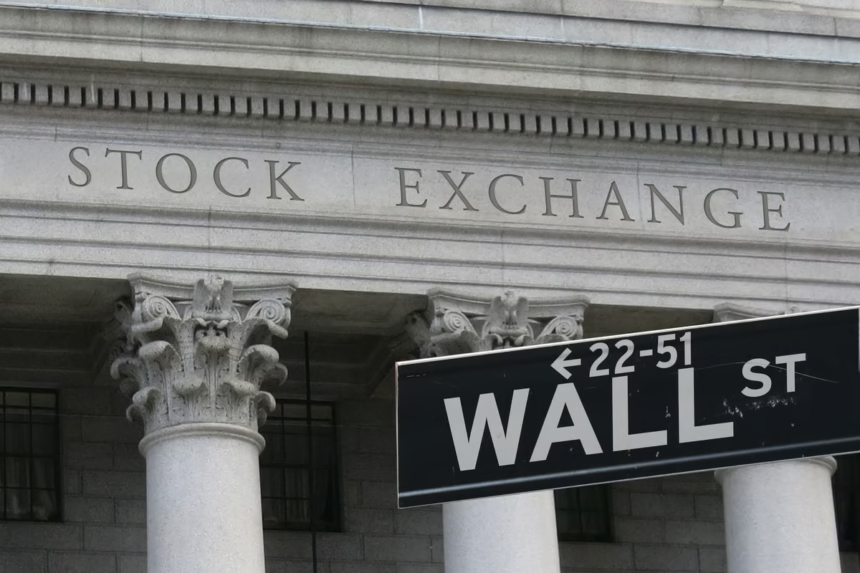
The S&P 500 index has recently marked an impressive chapter in its history, showcasing one of the most robust bull markets ever recorded. Over the past few years, the index delivered total returns of 26%, 25%, and 18% in 2023, 2024, and 2025, respectively. As of June 12, it has also logged a notable 7.8% gain year to date. This upward momentum follows a resurgence that began after the market bottomed out in March 2009.
However, as the benchmark index hovers near its all-time high, concerns regarding its valuation are beginning to surface among investors. Notably, the S&P 500’s Shiller price-to-earnings (P/E) ratio has surged to over 41, a level reminiscent of valuations seen during the dot-com bubble. Additionally, both the price-to-book and price-to-sales ratios for the index are reaching unprecedented heights.
Warren Buffett’s preferred valuation metric—comparing the stock market’s market capitalization to gross domestic product (GDP)—paints a concerning picture as well. Currently, the market cap of the S&P 500 is double the trailing 12-month GDP, a ratio that hasn’t been observed since 1929. When adjusted for prevailing Treasury bond yields, the S&P 500 is trading at its highest premium in over a century, dating back to 1920 based on CME Group data.
Despite these valuation concerns, several factors could indicate that the bull market has the potential to extend further. Analysts from CME Group, led by Erik Norland, point out some encouraging trends in the current market landscape.
First, corporate earnings have been witnessing substantial growth. While the Shiller P/E ratio reflects historical performance, the true value of a company is more closely tied to its future earnings capabilities. The S&P 500 saw significant aggregate earnings growth of 28.6% in the first quarter, with projections for full-year growth expected to reach 22.8%. This figure is notably higher than the traditional single-digit percentage growth averages.
Furthermore, corporate earnings as a percentage of GDP have recently hit a record high. Historical analysis from CME Group indicates that such earnings metrics peaked 15 to 36 months prior to stock price peaks in 2000 and 2007; currently, it appears that earnings have not yet peaked and are unlikely to do so before 2026.
In addition to corporate earnings, bond market signals provide valuable insights into investor confidence in the overall economic outlook. When investors exhibit confidence in corporate prospects, they often flock to high-yield corporate bonds, resulting in a drop in yield. A narrowing spread between corporate and government bond yields typically reflects heightened investor confidence. In contrast, a widening spread usually indicates a rising caution among investors, signaling potential market downturns.
As of late May, credit spreads remain near historical lows, further suggesting that any significant market plunge could still be years away.
Nevertheless, investors are advised not to let positive market signals lead to complacency. Maintaining vigilance while seeking to buy stocks at favorable valuations remains essential. Historical patterns aside, markets can shift unpredictably.
Emphasizing Buffett’s wisdom to be cautious when others are overtly optimistic, investors would be wise to remain wary given the elevated market cap of the S&P 500 relative to GDP. However, it’s crucial that this wariness does not lead to inaction. Investing in companies with strong competitive advantages in stable and growing markets can often yield long-term benefits that withstand market downturns.
Ultimately, while paying attention to valuations is important, it should be balanced with an understanding of future expectations for the individual stocks one intends to purchase. In some cases, it may be worthwhile to invest at a higher multiple for a superior business with promising growth potential. Even seasoned investors like Warren Buffett have been known to embrace this approach.