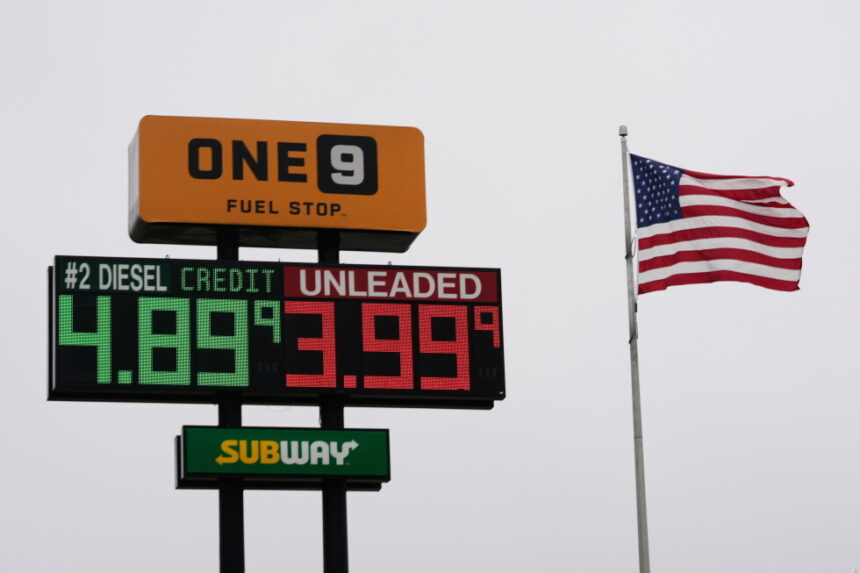
High oil and gasoline prices continue to challenge consumers worldwide, with energy supply issues anticipated to persist despite a recent agreement to end the Iran war and reopen the critical Strait of Hormuz. Industry experts indicate that the effects of this diplomatic breakthrough may not be felt for several months.
The logistics of shipping and refining crude oil are complex and will not resume at full capacity immediately. The Strait of Hormuz, a vital passageway where about one-fifth of global oil and gasoline flows, has remained largely inaccessible, with tankers stranded in the Persian Gulf for over three months during the conflict.
S&P Global Energy’s Daniel Evans pointed out the necessity for stability and security in the region before operations can be fully revitalized. Insurers will also need to establish confidence in the safety of maritime travel, which further complicates the timeline for resuming oil shipping. He emphasized the importance of a safety buffer for incoming ships to load and navigate out of the strait.
Following the announcement of the agreement, oil prices saw a slight dip, with Brent crude falling to $83.89 per barrel, a decrease of $3.45. Meanwhile, the U.S. benchmark crude dropped by $4.03 to $80.85 per barrel. However, these figures remain elevated compared to the approximately $70 per barrel level prior to the onset of the war.
Evans noted that once stranded vessels are able to exit the strait, new tankers will need to be summoned. This logistical maneuvering is time-consuming; oil tankers typically operate at a slow pace, and the journey from the strait to markets often extends over several months. Additionally, production in several Middle Eastern countries has been halted due to a lack of storage availability, complicating the restart process.
Countries such as Saudi Arabia and the United Arab Emirates, which have alternative pipeline routes to transport oil, may be positioned to quickly ramp up production. According to Alan Gelder from Wood Mackenzie, such countries are likely to see a faster return to normal operations compared to Iraq, which has faced more extensive production halts and operational difficulties. He estimated it could take up to a year for Iraq’s oil fields to recover fully.
Investment in the energy sector has also stalled following the strait’s closure, with analysts indicating that substantial time is needed to reinject capital back into the system. Daniel Sternoff from Columbia University noted that countries that have paused oil production will be cautious about resuming unless they are assured of a stable situation in the strait, as the durability of the ceasefire remains uncertain.
Overall, while the agreement to reopen the Strait of Hormuz is a positive development, the ramifications for global oil supply and price stabilization are likely to unfold over an extended period, rendering immediate relief to consumers unlikely.